It's a gravity survey satellite. They get better measurements if they fly closer to the earth, so there's a motivation to lower the orbit. GOCE flies so low that it needs to take aerodynamics into account, so it is sleek, like an aircraft.*
* It is, of course, actually an aircraft, like all satellites, to some degree, at least in the layman's definition of the word.
LARES is particularly cool, as it is (and may forever be) the densest object of its mass in the solar system. As so many gravity experiments go, systematic uncertainties are more-important than raw signal, though, so LARES 2 is composed of nickel instead of tungsten. It'll still be quite a day when LARES 1 re-enters; it'd be quite a sight to see.
I'm a little sad that the mission-planning team didn't include a "Look out below!" warning on the other side of the plaque.
Dropping a half-ton, two-foot-diameter, sphere of brass out of orbit is something of a health hazard to whatever life forms might have to catch it. If Miley Cyrus needs a follow-up hit, "Wrecking Ball" and "LAGEOS" have the same number of syllables.
What I think is even crazier is the GRACE mission with two sattelites chasing each other (fittingly named Tom & Jerry):
They use the fact that higher densities of gravity on the earth below accelerate one sattelite before the other. So the way they measure gravity is by very accuratly measuring the fluctuations in the distances of the sattelites.
This is a feat in itself, the sattelites are 200 km apart and the fluctuations are on the scale of the strength of a hair.
Maybe there are better more precise ways of measuring local gravity from space, but this is just so clever.
> It is, of course, actually an aircraft, like all satellites, to some degree, at least in the layman's definition of the word.
Aircraft use the surrounding air as support to counter the gravity. While lift has been measured for GOCE at different angles of attack, it never used it to stay at its altitude; the "wings" were just solar panels to feed the power-hungry engine and stabilize the attitude. At GOCE operating altitudes, the air is sparse, Knudsen number is high, and the aerodynamics differ quite a bit. It wasn't an aircraft, it was a "satelloid", an old idea that got implemented.
There are at least a couple companies trying to recreate the GOCE V-LEO concept for earth imaging. Apparently you can take better pictures when you're much closer to the earth.
Enough to cause some drag, and because of that it needed to have an aerodynamic shape and a continuously operating ion engine to avoid orbital decay because of that drag. But not enough air to actually produce lift, so no wings, just fins for stabilization. So the sleek shape which led to it being perceived as beautiful was actually technically motivated. To me it looks more like a rocket than an aircraft TBH...
The weight of the spacecraft in orbit is also extremely small, so the lift produced from the free flow hitting the surface at an angle is non-negligible. But as all weight is created by the drag from the same flow, reducing the cross-section is more beneficial. That's why it was designed to match the perfect orbital velocity at zero AoA, instead of using the lift.
A long time ago if one had a Dish Network / Echostar access card with the engineering guide byte set, you could see a couple live channels of each of the Echostar birds in space with key vitals overlaid on the feed. It wasn’t an image of a sat taken by another sat per se, but cameras on arms pointed back at the sat, a satellite selfie so to speak.
The engineering guide byte also allowed unrestricted access to all pay per view, adult channels, every local news channel from every US market, dish’s foreign satellite that had a wide breadth of international news channels (100+, from nearly every country on the planet)(iirc that bird was at 63.5 degrees?), and a live image of Dish’s control room with a wall of small TVs showing what appeared to be every channel playing at once.
> with the engineering guide byte set, you could see a couple live channels of each of the Echostar birds in space with key vitals overlaid on the feed. It wasn’t an image of a sat taken by another sat per se, but cameras on arms pointed back at the sat, a satellite selfie so to speak.
Wish someone out there has some old VHS or DVD recordings of those and can post them to the Internet Archive and share a link. I love things like that.
Yeah, relatively easy. You had to get an iso7816 smart card reader / writer and interface it to a pc. Then use a hex editor to find and flip the necessary bit. Pop the access card back into your sat tv receiver and now the system thinks you’re an echostar satellite engineer with everything on so you can test. This has been dead for a long time, I’m thinking around 20 years ago now, but it was pretty cool to read about and watch from the sidelines back in its heyday when there was an arms race between the sat tv services and folks doing things like this.
As someone who builds spacecraft I wonder how the engineers who built this particular one might feel.
One of the odd things about this industry is that once its built and launched, it is basically understood that it is never seen again by human eyes. I know I would deeply appreciate being able to see one of mine in orbit. Sort of a pride in knowing it is working away.
Makes you wonder. There must be a massive archive of satellite on satellite images somewhere and teams of people figuring out engineering capabilities/secrets from them.
There's already a commercially publicized satellite that went out into geostationary orbit, matched orbit with an end of life telecom satellite, rammed a probe up its rear end to latch onto it and took control over its station keeping. Google satellite mission extension vehicle.
I'd be shocked if this isn't a capability the DoD has developed to a very high level.
Spending 5% of their budget to cut Russia's military in half is an amazing value. And without putting any US lives into the conflict. Sending over weapons is a no-brainer.
What exactly is Russian going to do in retaliation? They've already failed to invade an ex-Soviet neighbor. At this point if I were Russian I'd be concerned Finland might just annex the whole country and nothing could be done to stop them.
While it does exist as an option, I'm not entirely convinced any significant number of the weapons they retain function. Their military seems to be in shambles. They have so many nuclear weapons that certainly at least a handful are usable, but how would they know what weapons function?
Russia already has been a hostile nation for more than a decade and will try to do as much damage as it can without incurring additional retaliation anyway. Nothing changes here.
Besides after more than a year of war this is an interesting but purely counterfactual analysis without much relevance for today.
> Russia already has been a hostile nation for more than a decade and will try to do as much damage as it can without incurring additional retaliation anyway. Nothing changes here.
Not quite, since there are taboos that even the Kremlin has been afraid to break so far. Such as poisoning diplomats, deploying weapons to space, messing with subsea cables, etc...
But theoretically they have less to lose than the U.S. because they have less diplomats, have less space assets, and so on. So one day the decision makers may be tempted to get one back.
Pretty sad that Ukrainian and Russian human lives probably didn’t enter any of that equation as having any value.
It’s likely extremely negative value when properly integrated into future potential outcome. For example the “badwill” it will generate from relatives and decedents of all the dead.
I doubt fueling war is ever a good strategy in the long run.
Compared to peace and prosperity, sure. Compared to Russia winning and subjugating more of the Ukrainian nation and population, much less so.
Who cares what the motivation of some bigwigs in Washington is, as long as they are helping Ukraine defending their country. It is Russia that invaded and annexed territories of its neighbor and who can end this war any time by going home.
It's also incredible advertising for western arms manufacturers, especially after several decades of them basically being the bad guys in the public's eyes.
I once worked on a project for Ball aerospace that was classified and all they could tell us was it was a spy satellite that spied on other satellites.
Planet once used a Dove satellite to take a series of stills (that is stitched into a video) of a rocket launch of other Dove satellites. Video here: https://www.youtube.com/watch?v=afiLd4zPoLQ.
Agreed. The focal range is something like 90KM to 1400KM based on this image and other off nadir images that have been shared by DigitalGlobe/Maxar, and it really makes you wonder what the focusing mechanism is fully capable of.
The distance to the earth might have been coincidentally the same as the distance to the other satellite. LEO isn't that far up, the one that took the photo was only ~600km AGL.
But then the resolution can't have been that high, or the other satellite would have been as big as the ISS. It must have been a lot closer than earth.
They've got 0.3m on World View 3, more than enough for what was shown in the gif
Edit: you're probably right, actually.. the silver square on the lower section of landsat 8 is ~1.5m high (guessing from the image on wikipedia), so there should only be ~5-6 pixels for it, but there are clearly more.
N is nadir and points to the closest point on the Earth under the satellite. V is the velocity vector, it's the direction the satellite is heading. S is the vector pointing to the sun.
The satellite taking the picture had to slew to be pointing at Landsat-8 for a couple of frames. It is the relative positions between the satellites that changes, the vectors themselves don’t move that much in a short period of time- the nadir and velocity vectors rotate 360 degrees in one revolution around the Earth (relative to an earth center inertial reference frame). The Maxar satellite and Landsat-8 are in different orbits. It appears from the video that the Maxar satellite passed under Landsat-8, as evidenced by the nadir vector pointing straight at the screen toward the end of the video, and because we got a broadside view of the white Earth shield for the thermal imager.
I don’t have context but if that’s real they are most certainly next to each other intentionally. Being miles away from each other with velocities hundreds of miles an hour different is considered an extremely close call.
Those are the Van Allen Probes A and B, and that is just a render, not a photo. [0]. There are two of them that flew in an identical orbit, but with one following the other at a distance, because a single probe would not be able to detect the difference between a transient EM field locally vs. a moving event along the orbit, but two craft spread apart but following the same path could.
No. Countries of the world have been imaging each others satellites for decades. The only thing that has changed recently is that now companies can do this commercially in an unclassified manner.
Seems unlikely given it's one of our own satellites, a "civilian" satellite, and doesn't demonstrate (I don't think?) any capabilities against satellite stealth techniques?
'Hostile' foreign governments, even the really incompetent ones, know lots of information our own government won't tell us. A lot of 'classified' stuff is more about hiding the budget from public oversight than actual "keep the other guys guessing."
I'm sure most of the other nations who want to play games with what their satellites look like / can do, are already fairly aware of the US government's capabilities in that regards. Certainly some of our terrestrial capabilities after a certain someone advertised them to the world a few years ago...


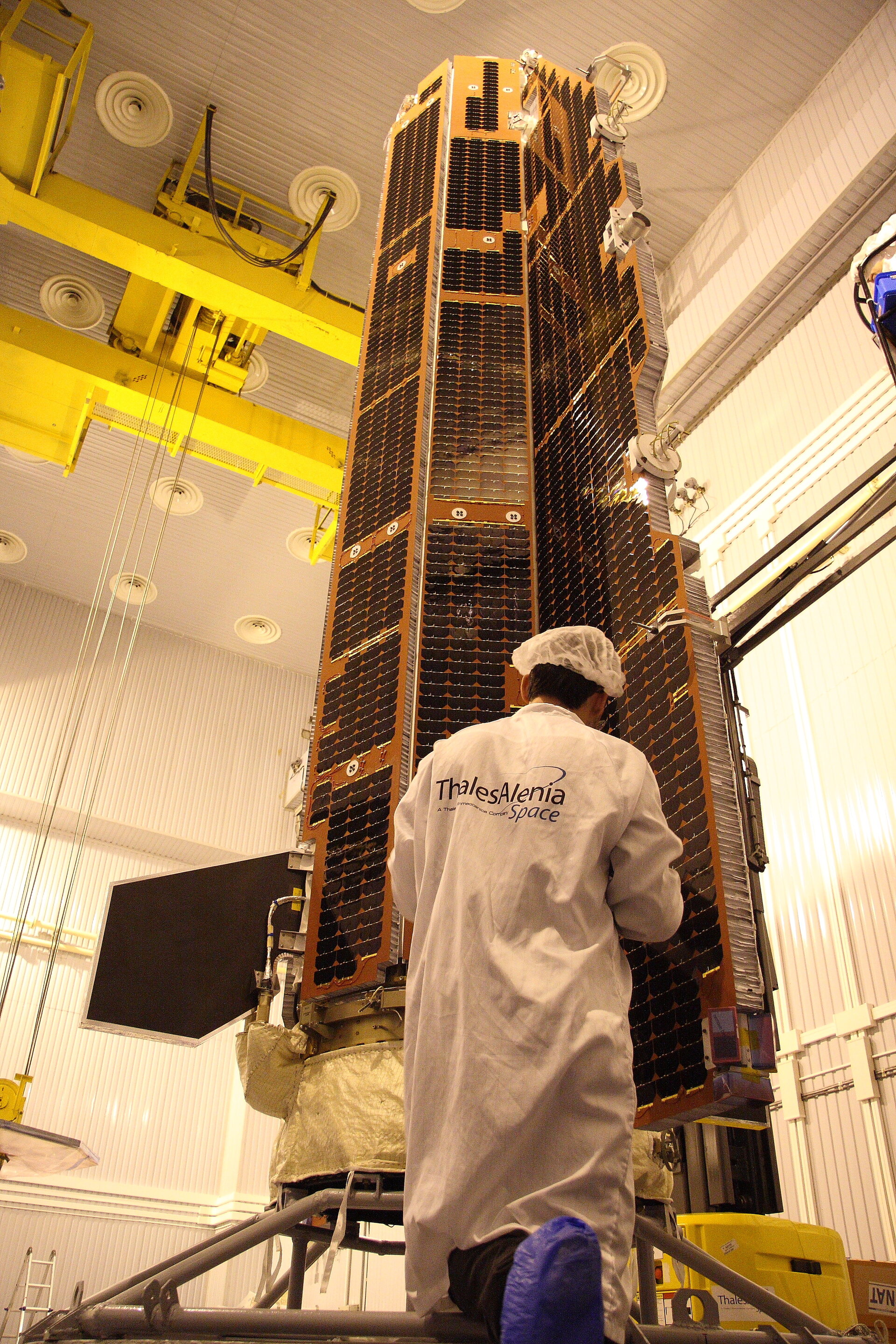

GOCE: https://en.wikipedia.org/wiki/Gravity_Field_and_Steady-State...
It's a gravity survey satellite. They get better measurements if they fly closer to the earth, so there's a motivation to lower the orbit. GOCE flies so low that it needs to take aerodynamics into account, so it is sleek, like an aircraft.*
* It is, of course, actually an aircraft, like all satellites, to some degree, at least in the layman's definition of the word.