It's a gravity survey satellite. They get better measurements if they fly closer to the earth, so there's a motivation to lower the orbit. GOCE flies so low that it needs to take aerodynamics into account, so it is sleek, like an aircraft.*
* It is, of course, actually an aircraft, like all satellites, to some degree, at least in the layman's definition of the word.
LARES is particularly cool, as it is (and may forever be) the densest object of its mass in the solar system. As so many gravity experiments go, systematic uncertainties are more-important than raw signal, though, so LARES 2 is composed of nickel instead of tungsten. It'll still be quite a day when LARES 1 re-enters; it'd be quite a sight to see.
I'm a little sad that the mission-planning team didn't include a "Look out below!" warning on the other side of the plaque.
Dropping a half-ton, two-foot-diameter, sphere of brass out of orbit is something of a health hazard to whatever life forms might have to catch it. If Miley Cyrus needs a follow-up hit, "Wrecking Ball" and "LAGEOS" have the same number of syllables.
What I think is even crazier is the GRACE mission with two sattelites chasing each other (fittingly named Tom & Jerry):
They use the fact that higher densities of gravity on the earth below accelerate one sattelite before the other. So the way they measure gravity is by very accuratly measuring the fluctuations in the distances of the sattelites.
This is a feat in itself, the sattelites are 200 km apart and the fluctuations are on the scale of the strength of a hair.
Maybe there are better more precise ways of measuring local gravity from space, but this is just so clever.
> It is, of course, actually an aircraft, like all satellites, to some degree, at least in the layman's definition of the word.
Aircraft use the surrounding air as support to counter the gravity. While lift has been measured for GOCE at different angles of attack, it never used it to stay at its altitude; the "wings" were just solar panels to feed the power-hungry engine and stabilize the attitude. At GOCE operating altitudes, the air is sparse, Knudsen number is high, and the aerodynamics differ quite a bit. It wasn't an aircraft, it was a "satelloid", an old idea that got implemented.
There are at least a couple companies trying to recreate the GOCE V-LEO concept for earth imaging. Apparently you can take better pictures when you're much closer to the earth.
Enough to cause some drag, and because of that it needed to have an aerodynamic shape and a continuously operating ion engine to avoid orbital decay because of that drag. But not enough air to actually produce lift, so no wings, just fins for stabilization. So the sleek shape which led to it being perceived as beautiful was actually technically motivated. To me it looks more like a rocket than an aircraft TBH...
The weight of the spacecraft in orbit is also extremely small, so the lift produced from the free flow hitting the surface at an angle is non-negligible. But as all weight is created by the drag from the same flow, reducing the cross-section is more beneficial. That's why it was designed to match the perfect orbital velocity at zero AoA, instead of using the lift.


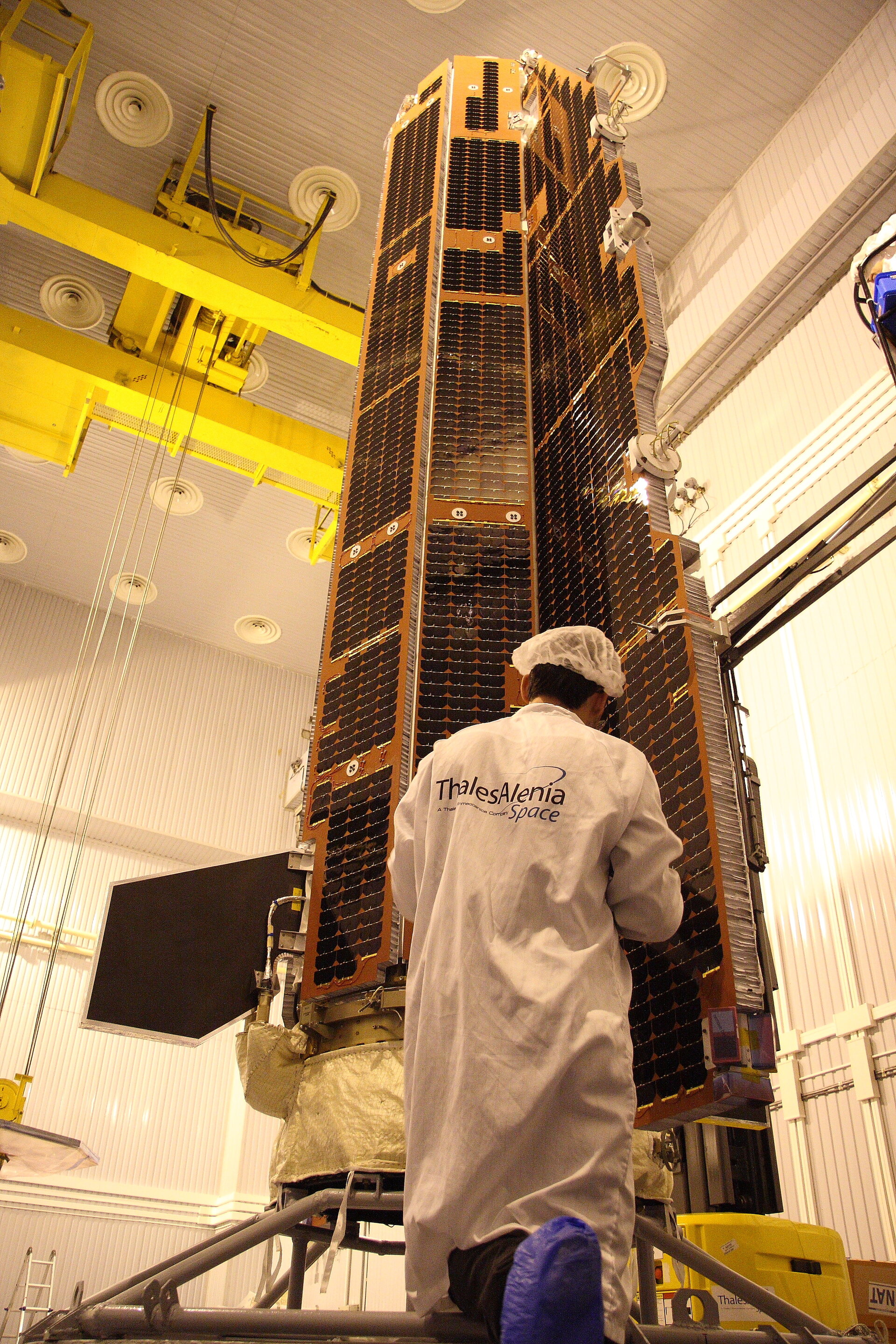
GOCE: https://en.wikipedia.org/wiki/Gravity_Field_and_Steady-State...
It's a gravity survey satellite. They get better measurements if they fly closer to the earth, so there's a motivation to lower the orbit. GOCE flies so low that it needs to take aerodynamics into account, so it is sleek, like an aircraft.*
* It is, of course, actually an aircraft, like all satellites, to some degree, at least in the layman's definition of the word.