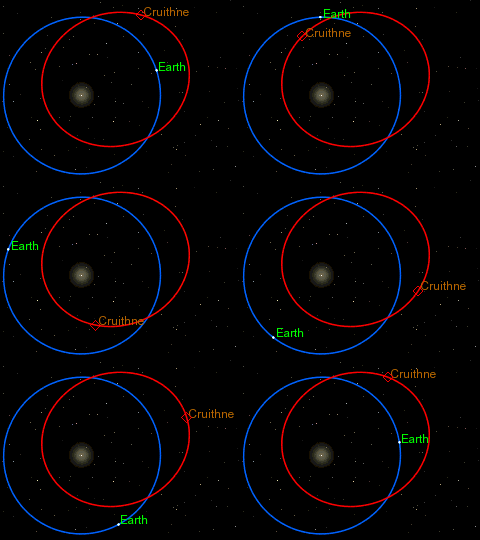
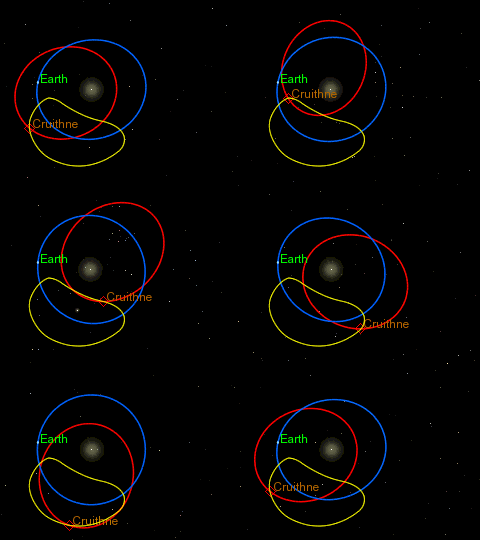
As pointed out by the other commenters, Cruithne doesn't orbit the Earth, but orbits the Sun with the in 1:1 resonance with the Earth. Its orbit is highly elliptical: at perihelion it's closer than Mercury, and aphelion further than Mars. Much of the time it's actually on the other side of the Sun to us. Here's a couple of gifs of its orbit:
The yellow kidney bean orbit depicted only takes a year, but it doesn't actually form a loop, and the kidney bean moves gradually away from the Earth around the blue circle. When it goes almost all the way around, it's going to start going back in the opposite direction. 770 years is the time it takes for the yellow orbit to traverse the blue orbit once in each direction.
Not only does it not orbit the earth in any physically meaningful sense - it doesn't even trace a shape that goes around the earth, which is annoying because I'm pretty sure I've told people that it did.
Is 1:1 really a resonance though? Any object with a similar semimajor axis will enjoy this orbital period, so it could just be a spatially defined coincidence.
Earth actually has a few better quasi-satelites. (164207) 2004 GU9, (277810) 2006 FV35, 2014 OL339 [1][2][3] these are very small bodies typically ~100-300 meters by 50-200 meters.
That also orbit in 1:1 resonance with the earth, their orbits are less eccentric (not sun diving), meaning they can be reached with relatively very low D-V requirements on the order of 11-13km/s, also incredibly weak gravity of their own. (This doesn't count trojan bodies that orbit Earth/Sun L4/L5 points, which have been observed [5]).
Most quasi-satellites are typically temporary, Neptune currently has a large one ~250km long, Venus even has one that'll only orbit for another 500 years [4].
I like the convention in most space-exploration sci-fi of calling natural planetary satellites "moons" and stars with planetary systems "suns", but calling our sun "Sol" and Earth's moon "Luna".
I bet there's a word for that - using the more general term for something as a proper noun when the meaning is obvious from context. Like calling the largest nearby city just "The City". I figure it's the same general idea behind calling it "The Moon".
    moon (n.)
        Old English mona,
        from Proto-Germanic *menon-,
        from PIE *me(n)ses- "moon, month"
That's a straight line of descent from proto-Indo-European to modern English. No borrowing at any point.
Interestingly, etymonline also points out that the english word "moon" is cognate with the classical Greek word for the moon "mene". This leads nicely into your more interesting, and less wrong, claim:
> the Greek name for the body was Io
This is a little unconventional. I'm not really trained in classical Greek, but I also thought the word was selene.
Doing a simple search of greek dictionary entries through perseus ( http://www.perseus.tufts.edu/hopper/definitionlookup?type=be... ) quickly tells us that there are many, many, many greek words relating to the moon that use a form of selene or mene (aselenos, moonless; selenion, moonlight; hyposelenios, under the moon; triselenos, of three moons; numenia, the new moon; dichomenia, the full moon; skotomene, moonless night; etc. etc. etc.) Further inspection reveals that the term selene never appears in Homer, while mene does, so mene is probably older. (Knowing that mene comes from a PIE root also supports the idea that it's older.)
Io also appears, with a short gloss of "the moon". But the related dictionary entries don't really deal with that sense; they prefer to define Io as the mythological daughter of Inachus. But there is a citation to "Eust.ad D.P.92" in which Io is the "name of the moon at Argos". Wikipedia's entry on Io (the mythological figure) also says, "The ancients connected Io with the Moon", with a citation to "Eustathius of Thessalonica commentary on Dionysius Periegetes, 92", which looks like the same thing as the LSJ cite perseus gives. Wikipedia also cites this to a 10th-century Byzantine encylcopedia which Eustathius is known to have been familiar with, and to a 5th-century Greek philologist. None of those cites go to web resources, and I would be unlikely to get much out of them even if they did, but it does appear that there was a minor strain of referring to the moon as Io in some places at some point.
But selene and mene are clearly better candidates for "the word for the moon", since only they are used to form moon-related words. (Really, there are two words for the moon -- both terms appear as goddesses, but obviously have an ordinary, non-divine sense.) As far as I can see, Io is a mythological allusion, not "the word for the moon". It's even capitalized in the dictionary entry with the moon gloss.
How'd you learn that the Greek name for the moon was supposedly Io? Do you remember?
Finally,
> Luna was the Roman goddess represented by the body.
Sure, that's true, but luna is also just the ordinary Latin word for the moon. You might notice that the same thing happens with both selene and mene. Personification deities are dirt-common in classical literature. Take the goddess who started the Trojan war, Eris. She's referred to (by us) as the goddess of discord. And Eris isn't really a name -- it's just the word for quarreling and strife.