HOLY COW. Thank you for this. I LOVE the Ti99/4a, its one of the first computers I ever used. I've got one up and running at home now currently and can't wait to try this.
Btw, there is a lovely third party replacement for the TI99/4a video chip that lets you output VGA. It’s a major life improvement if you are seriously using it. I Dremeled my case but you can route the ribbon cable to avoid it if you’d prefer not to modify anything. Happy to send you a link if you don’t already know about it.
Thanks! I've got mine running in to a 9" Pelco PVM and it works well but yea, its tiny. I'd love to plumb in VGA and use a 15" flat panel. Would love a link.
There is very little documentation with this device but fortunately several YouTubers have made long videos showing every detail of the replacement. Enjoy!
@UsagiElectric on YouTube has a series of videos on building a homebrew around the TMS9900 processor. Would be cool if a unix-like OS could be used on something like that, though sounds like this project is specifically targeting the TI-99/4A system.
The TI-99/4A was the first computer I owned as a teenager. I had used TRS-80s and Apple ][ at school. I eventually bought the expansion box and a couple of accessory cards (floppy disk drive, memory and RS232). It all went in the e-waste dumpster about 20 years ago during a move.
I had one in grade school. Taught me the value of backups early in life. Spent all night typing in a game from a magazine. Started it without saving to tape first. It was so loud! Panicked and restarted the machine. Sadness ensued.
Replaced it with a C128-D. Didn’t get my first intel until I bought a 386 after graduating high school. Good times.
Same here - parents bought one for me in 1982, IIRC. By 1984 I had moved to Atari XL, but I'll always have a soft spot for the TI-99/4A, Extended Basic cartridge, speech synthesizer, cassette drive, etc.
My sister and I used to co-type programs from "Compute!". The times were so much simpler then..
The TI99/4A was also my first computer. I was about 5, and I didn’t really seriously try writing programs until I was about 8. Fortunately, since my father bought this for work, we had a large collection of peripherals, including the floppy disk drive. Unfortunately I learned the hard way why my father stopped using it: peripheral expansion bus devices were exquisitely sensitive to static shocks. I remember reeling in horror after watching hours of work just disappear from the disk drive. I suppose this was probably a good lesson to learn at an early age!
I have a bunch of TI-99 hardware in storage, have been thinking to donate it to a computer museum potentially. I had one in my hand when I was 5 thanks to my grandpa (it made me what I am today!).
TI-99/4A was my first computer as well. I still have two of them, and they still work as well as they did in the '80s. I graduated to an Apple ][GS which I still have as well, although it needs some TLC before attempting to boot it so as not to let out the magic smoke.
Same, though I bought one off Facebook marketplace recently- minus the expansion box. Lots of memories learning programming and the explosively better 'Extended Basic' vs the built in version.
My parents bought one for the house when I was in elementary school. I still remember the sound of the Speech Synthesizer, discovering 20 GOTO 10, and playing Hunt the Wumpus.
Interesting project. IIRC, one of the biggest challenges with the TI-99/4A was its TMS9900 processor. It was a 16-bit CPU, but had a really awkward memory architecture that made it difficult to write efficient code.
The lack of dedicated registers meant a lot of memory access, which slowed things down considerably. This is probably why it never gained the same traction as the 6502-based systems like the Apple II or Atari.
I'm curious to see how this UNIX-like OS addresses those limitations. It's a pretty neat accomplishment if it can provide a usable environment on that hardware.
The lack of dedicated registers meant a lot of memory access, which slowed things down considerably.
It gets worse because the TI99 only has 256 bytes of RAM directly addressable on its 16-bit bus. All the other memory in the system is video RAM and is accessed 8 bits at a time through the video display processor. Oh, and you can only do this when the VDP is not accessing the memory. This is incredibly slow and severely hobbles the potential performance of the CPU.
The whole thing seems like it was designed in a parallel universe, or at least it reeks of some kind of a sunk-cost-fallacy design-by-committee thing.
Supposedly what happened is that the system was originally designed to have either an 8-bit CPU, or a 16-bit CPU with an 8-bit bus (cf. 8086/8088) like TI's own TMS9985, but at some point it was decided that they should instead cram their full 16-bit TMS9900 minicomputer CPU (!) into the thing. This decision basically tanked the whole architecture.
It was too late/too expensive to redesign the 8-bit support chips to 16-bit counterparts so they had to make some really out there decisions like "talk to the graphics chip and give it an address to read/write every time you want to use memory" and "software is written not in machine code, but in GPL (Graphic Programming Language), which is then interpreted by the CPU and turned into actual TMS9900 machine code"
Software on ROM cartridge for the system is stored in GPL and is fetched from ROM by the CPU (but wait! The ROMs are not in memory space like they would be on a sane computer; they are SERIAL ROMs read 16 bits at a time with memory mapped I/O) and interpreted to machine code. This is slow. When you write your own software in BASIC, however, this gets worse: now you're writing BASIC, which is being interpreted and turned into GPL, stored in video RAM, and then fetched back from video RAM and turned into machine code by the CPU. THIS IS EVEN SLOWER.
Needless to say, the BASIC on the TI99 is dramatically slower than the already slow implementations on other contemporary micros.
It DOES have a full 16-bit CPU which is theoretically much more powerful than a 6502 or Z80 but this wild-ass implementation of... well, everything, makes the system probably the least capable machine of the era.
RAM was very expensive then and 16 bit CPUs weren't that much faster to justify the cost if you were aiming for the home market.
Both true, which makes this an even more baffling choice -- why pick the more expensive, state of the art 16-bit CPU* that you're getting little or no benefit from + 16K of extremely slow-to-access combined video and system RAM? You could have used a cheaper 8-bit CPU and maybe for the same budget have fit 4K or 8K of system RAM on the bus + some amount of dedicated video RAM for the VDP. This would have been faster and more useful in nearly all real world applications, make for a much cleaner board design, easier development, and probably cheaper. That's what everyone else did.
Then again, what was this machine's target market?
* The reason is probably that TI wanted to show off their state-of-the-art CPU tech and be able to point to the spec sheet and say "look, it's 16 bit! All our competitors are only 8 bits -- that's half as many bits!"
The 16K memory block is connect to the TMS9918 video chip and is accessed by port read/write. The TI-99 out of the box only has 256 bytes of RAM memory on the 16 bit buss.
UNIX99 uses an after market card with 1Mbyte of RAM on an 8bit external buss used for peripherals. This card replaces the old 32K RAM card made by TI in the 1980s.
It's cool because the registers are all in RAM, with a "workspace pointer" on the CPU pointing at where they are. This is slow, but a context switch is just changing that pointer.
It's not all that slow as a concept at that time when RAM speeds were as fast as CPU speeds. I think it's just that TI's implementation of the concept in that particular cost-optimised home computer was pretty bad -- the actual registers were in 256 bytes of fast static RAM, but the rest of the system memory (both ROM and RAM) was accessed very inefficiently, not only 1 bytes at a time on a 16 bit machine, but also with something like 4 wait states for every byte.
The 6502 is not very different with a very small number of registers and Zero Page being used for most of what a modern machine would use registers for. For example (unlike the Z80) there is no register-to-register add or subtract or compare -- you can only add/sub/cmp/and/or/xor a memory location to the accumulator. Also, pointers can only be done using a pair of adjacent Zero Page locations.
As long as you were using data in those in-RAM registers the TI-99/4 was around four times faster than a 1 MHz 6502 for 16 bit arithmetic -- and with a single 2-byte instruction doing what needed 7 instructions and 13 bytes of code on 6502 -- and it was also twice as fast on 8 bit arithmetic.
It was just the cheap-ass main memory (and I/O) implementation that crippled it.
Well, it has 256 bytes of RAM which is basically a really big register file, and everything else goes in the 16kb of "video RAM" which you can read and write by poking at I/O registers. So it is not easy to program.
It's arguably the only 8-bit computer which has a really different architecture from the others. You could otherwise imagine pulling the SID chip off a C-64 and putting it on a TRS-80 Color Computer etc.
Sharing the main RAM with video was a weak point in computers of that time period because the video system stole many of the memory access cycles. Some recent retrocomputers that revisit that period like
have a full-size memory bank and a video RAM memory bank which is accessed through a port which can be pretty efficient because you can auto-incremement the address register and just write 1 byte to the port to write 1 byte to video RAM and repeat.
Yep, but it lacks a MMU so memory protection and paging are going to require a lot of work. I think the only reason this is feasible at all is they're running the OS out of a ROM cartridge.
The PDP machines that Unix was developed on had MMUs, which they needed because the 16 bit processors couldn't address the multi-megabyte address space the hardware supported.
The PDP-10 had an MMU similar to a modern MMU with page tables and such, the PDP-11 had an 8-segment-of-8kb MMU like what the TRS-80 Color Computer 3 had except the PDP-11 had a real supervisor mode and if a user mode program tried to change the MMU configuration it would fault.
In fact the 9900 itself was used in an entire line of minicomputers that included a hardware memory map.
The 9900 is a single chip implementation of the CPU board in the TI 990. They even created a dedicated memory mapper chip to go along with the product line, though it is significantly different than the one in the minicomputer line.
(edit: the 990 was first built in the early 70s, memory mappers are quite old conceptually)
(edit 2: in fact the necessity of using a memory mapper is what killed the platform, and was one of the things that made the IBM PC team decline the 9900.)
Unfortunately I don't think that there is a reasonable way to perform real hardware-level memory protection with that chip alone. I'm working on a project documenting the genesis of the 99000 chips, which include a privilege bit in the status register, from the minicomputer line.
Essay forthcoming, and probably an OS. Maybe a year...
One chip that could be used as a memory mapper for the 9900 (but wasn't in the TI99/4A) was the 74LS670, which was used in the IBM 5150 PC to allow the 8237 DMA chip to access more than 64KB (a limit that wasn't a problem when used in a 8080 system).
What features does one specifically mean by "UNIX-like"? Unified filesystem with a single root? A CLI shell with the classic abbreviated comands? Preemptive multitasking? Multiuser-oriented permissions?
the BLWP (Branch and Load Workspace Pointer) instruction essentially does a hardware context switch in two memory accesses -- it swaps the whole register set by changing a pointer, not copying. for a microkernel doing lots of IPC, that's a nice primitive. the 9900 predates L4 by two decades but the workspace design maps well to the message-passing model.
I'm still happy about FUZIX on the RP2040 (last discussed here two month ago https://news.ycombinator.com/item?id=46271115 ). A capable SoC that costs around $1.
Only via (USB) serial so far, but that works for me.
I learned to program on this exact hardware in the early 80s as a small child. It uses BASIC. It's hard drive was modem tones recorded to an analog audio tape. Its monitor was an analog TV. There was no mouse. The keyboard was built into the computer itself.
> LNG is an operationg system primarly for the good old Commodore64 home-computer. There also is a native version for the successor Commodore128. Ports to other 6502/6510 driven 8Bit Computers are possible but not yet started. LUnix started in 1993 and reached the internet in 1994.
I'm not sure how practical it actually is, but I did play with it in an emulator and it's pretty impressive for what it is. I mean, the C64 really should not be capable of preemptive multitasking, but they somehow pulled it off.
It's extremely slow, which isn't surprising, but I still think it's pretty neat.
A USB video capture device or a converter box. There are devices sold specifically to interface these old machines with modern displays. One of the more famous ones is the RetroTINK.


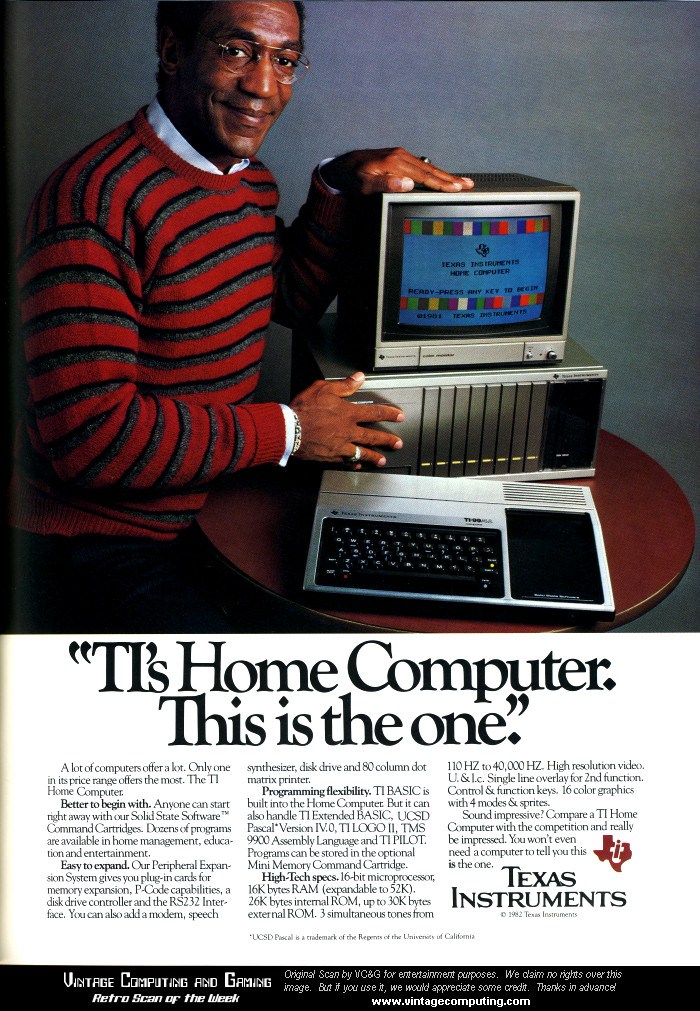
It was called the Geneve 9640 from Myarc:
https://dressupgeekout.com/geneve/
http://www.mainbyte.com/ti99/geneve/geneve.html
Wikipedia has a decent article:
https://en.wikipedia.org/wiki/Geneve_9640
12 MHz un-crippled 16-bit CPU, 80 column text, 256 colour graphics, up to 2 MB of RAM.
That would be much more promising for a Unix-like OS!
They are extremely rare these days, but a cheapo emulation would be great fun -- it's able to run most software for the 99/4A.
reply