Something has deeply deeply changed in society for a fertility rate to go from 6 to 0.8 in 60 years, the living memory of a single life.
Before, society grew with the average working age person only needing to half support an elderly retiree. Now, that same working age person will need to support more than 2 elderly retirees themselves, over 4 times the resources.
Has it occurred to people that, maybe, modern fertility is a tragedy of the commons? If everyone chooses to act in their own interest, society is worse off than collectively pressuring to have more kids? Ideally, that would look like major subsidies and benefits to parents to account for the extra work they are doing for society.
I fear if nothing else changes, developed countries are dysgenically wiping themselves off the planet, and the traditionally oppressive-to-women societies will evolutionarily outlast us.
At this rate, there will only be 3m South Koreans in 3 generations. I don't see how you expect a country to survive that decline. In 1960, Pakistan had 45m people compared to South Korea's 25m. Now, Pakistan is forecasted to reach 450m in our lifetime as South Korea implodes. That looks like our future.
There's just a lump in the population vs. age graph and you're fixating on the back side of the lump as if it's inevitably going towards zero.
After the lump passes through South Koreans will look around and see a lack of traffic congestion, abundance of housing, lack of competitors for their now abundant resources, and lack of disproportionately large population of unproductive elderly dependents.
Wanna guess what happens in that welcoming environment? My guess is people feel inclined to make some babies.
I don't understand why people tend to treat these low fertility rates as some kind of invariable biological dysfunction. These aren't infertile masses of people; they're perfectlycapable of multiplying like rabbits.
The planet has shitloads of people, maybe we're finally reeling things in from an overshoot and are on the inevitably pendulum-like path towards population stability. There's no reason to panic unless you've got substantial evidence these people are physically incapable of having children.
Edit:
How about some DATA: go to https://population.io, select Rep. of Korea, plug in some age/gender b.s. and scroll down to "Age Distribution" at the left column. Now look to the left of ~20yo (younger than 20), it's a nearly horizontal line. What does that tell you? There's a uniform rate of Korean babies per year under 20 years old. To the right of this, there's a massive lump of elderly people with a slightly smaller lump of middle-aged people. There's no reason to believe this horizontal line left of 20yo won't just continue into the future; it looks quite stable for the last ~20 years.
>Wanna guess what happens in that welcoming environment? My guess is people feel inclined to make some babies.
I would assume the exact opposite given that this will probably probably crank up pressure on working-aged people as more and more old people need to be supported by fewer and fewer young. I would also assume a significant exodus of the young to places with actual opportunities rather than a country sized retirement home where no one wants to invest in the future because anything built to fit the needs of the population at any given moment will be massively overbuilt in the near future.
This was my exact same though while reading OP's comment. Taxes will go way up since the number of people having to support all the old people will be fewer and fewer. The increased taxes will cause people to have fewer and fewer children. It's a vicious cycle.
we have the same kind of situation in America just a little behind, so here are my thoughts "as a young person": none of my peers want to pay for that. we're not going to sit around letting old people leech from us instead of working. and at the end of the day younger people hold more physical power and more working ability so we will have the final say regardless of how many old people there are to vote themselves our $. i expect that if they try this a couple things might happen:
1. young people leave for better states
2. young people outvote old people (not likely)
3. young people refuse to pay and force the government to raise the social security age to 83.
i hope it's 3. in 1935 the average life expectancy was 60 to a social security age of 65, so 1.08 times the life expectancy. the life expectancy now is 77, so keep the same 1.08 times and we have a minimum age of about 83.
it really baffles me how the same generation that talks about how "millennials and gen z wont work hard" literally wants to force us to pay for their retirement. they had 65 years to save up money, they can pay for it themselves.
> young people refuse to pay and force the government
How they would be able to "refuse to pay" if payment will come as form of taxes for goods and services? And moreover they won't be able to "force" government to anything since government will be representing and working for the majority of people who voted for them: older generations
Fortunately tax policy can be adjusted to encourage things you want to happen within a society. If taxes are punitive, tax credits for having children would lead to a baby boom based on the same logic.
I'm not sure encouraging more children will help long term though. Eventually we need to figure out how to make society work without population growth.
This feels like a non-issue. The boomer generation is probably one of the wealthiest generations in history. And the younger generations have for the most part been fairly underemployed. Feels like there is more than enough slack in the labor markets to handle the extra work, and taxes could be targeted towards the wealth assets of the boomers (stocks, real estate, etc...).
Don't know what it's like in Korea, but in China, it's pretty common to have pension higher than local average salary if you were in the state job system, which is absolutely huge. This is due to the polical power dynamic.
Many provinces are barely scraping by, young workers are not only effectively directly supporting pensioners, they are now delaying young workers retirement age, and you better not believe the old folks will willing to eat into their own money.
> After the lump passes through South Koreans will look around and see a lack of traffic congestion, abundance of housing, lack of competitors for their now abundant resources, and lack of disproportionately large population of unproductive elderly dependents.
It will take 90 years for this lump to pass, and another 20 years for the newborns to grow up... you're talking about a recovery that will take a century...
A century of decline seems like a pretty good reason to panic to me...
> It will take 90 years for this lump to pass, and another 20 years for the newborns to grow up... you're talking about a recovery that will take a century...
More like ~53 years for all the current lumps to pass given a life expectancy of ~86.
> How about some DATA: go to https://population.io, select Rep. of Korea, plug in some age/gender b.s. and scroll down to "Age Distribution" at the left column. Now look to the left of ~20yo (younger than 20), it's a nearly horizontal line. What does that tell you?
Yeah, something is definitely wrong with the site because actual population pyramid data looks much more alarming:
Also it matches up with the article, which says 261k babies were born last year. wikimedia show about that, with ~130k male and ~130k female. population.io says 454k which is way off.
> it's a nearly horizontal line. What does that tell you?
That the data must be wrong, there should be some small variation and it doesn't pass the sanity check of declining birth rates.
> After the lump passes through South Koreans will look around and see a lack of traffic congestion, abundance of housing, lack of competitors for their now abundant resources, and lack of disproportionately large population of unproductive elderly dependents.
I like your optimism, but do we see anything like that in the real word after depopulation? There are many shrinking cities or areas, eg Detroit in the US or East Germany (people moving to the west), and the results are hugely negative and a downward spiral. Instead of people enjoying lack of traffic congestion, shrinking cities can't afford their oversized infrastructure anymore, which begins to deteriorate from lack of upkeep.
Grossly, south korean couples each makes 1 child. So its population is going 1/2. To correct that and return to previous level, every couple formed among those children would have to bear 4 children.
Why do you assume the current population is the correct one? There’s a reasonable argument to be made that humans are over the Earth’s carrying capacity nearly everywhere, and are causing environmental and social damage to maintain the current size. It is quite normal in ecology to see crashes and recovery in the event of overpopulation. If we assume humans are biological organisms, it all seems pretty normal.
Except unlike the foxes which eat their rabbits to near extinction, and therefore soon join them, humans can change the rules of the system they're in.
Calculating the carrying capacity of the world before agriculture would have given you a much different number than after it.
Okay, sure, but none of that changes what I wrote. Past performance is no guarantee of future results. Nor that improvements to Earth’s habitability will be timely, nor whether incentive structures will line up to implement the changes needed.
My scenario is several orders of magnitude more common than yours. It doesn’t mean you’re wrong; miracles do happen. It must be nice to have so much blind faith in technological progress and human exceptionalism, but I’m going to stay with my ecology and statistics.
It's several orders of magnitude more common in species which have orders of magnitude less ability to impact their environment and change the way they live (and to humans in the past when we were no different).
It is not blind faith to say that we should expect that the different dynamics could be different when the rules of the game are different.
Again, if the foxes see the rabbit population declining and can start producing rabbit substitute before they start starving, of course we would expect a different dynamic to be possible.
Except that humans are now in a situation where modern medicine has also allowed us to live much longer. The natural cycle of birth-aging-death has been disrupted. You suddenly have a world where there are too many 80 year olds and not enough 8 year olds.
After that lump passes through, you may have suffered a huge drain of adults expected squeezed so hard for child and elder care that they've since taken their productivity elsewhere.
Apologies for ranting but this topic resonates too much.
Housing prices are 9x salary vs 4.5x salary in the 70s and it takes a while to save up. Personal data point: it took me winning an IPO lottery to start thinking about having kids for real. Having kids while earning minimal wage? Terrifying, especially in the US where getting yourself or your kid sick could bankrupt you in the blink of an eye - and if you want multiple kids you increase the risk.
So we think we have to have it all before we start trying having kids and have no sense of community whatsoever. Societal focus on hedonism and career leaves little to no time to raise kids. And at the end of the day you end up having no support from the society that slowly but surely ages.
I agree with you on the latter point, but I want to also point something out on the former. Many people who are of no "proper" means to do so continue to have children. And they make it work, even if it may be uncomfortable and require sacrifice. So the issue is not one of finances, but priorities. Winning an IPO lottery being the baseline where you feel comfortable for having children doesn't mean that such is the inherent baseline, but that you simply prioritize comfort and wealth over raising a family. And that is okay.
This nuance is important; it emphasizes the real issue is not economics, but culture! We've created a society that values the pursuit of wealth and comfort more than family, and it's likely this system is not sustainable. Not everybody can be wealthy, because wealth is relative and mediated by what exists. If 30% of people want something and there's only enough for 3%, then it doesn't matter what the relative wealth is among these people: 90% of people won't be able to "afford" it, and that will never change. A post-scarcity society will never exist alongside consumerism; we'll simply take what we can have for granted and lust over the new scarcities.
We shouldn’t ignore the trauma that those children often experience, though. My parents had me at 17 and 19 years old, and I had a rough, complicated upbringing that caused me lasting damage. Because of that, I personally don’t see myself as having children ever, and I’m lucky enough to have a partner that feels the same.
>Many people who are of no "proper" means to do so continue to have children. And they make it work, even if it may be uncomfortable and require sacrifice.
Unfortunately many people who are not properly equipped to raise children (financially, temperamentally or otherwise) have lots of children and don't make it work. The result is a permanent underclass and a serious crime problem in many of our major cities.
I think we can find some middle ground between "I won't have kids until I can afford to send them to Harvard" and "I'll have 7 kids while being addicted to drugs and having no family to support me".
I think a lot of that underclass is artificially propped up too, sort of along the lines of thinking you hear with open immigration vs generous welfare state pick one.
But the people having kids are the ones with less money. The parents in my neighborhood are middle class (I mean like cops and admin assistants) and there’s three families with three kids just within 8 houses. Meanwhile among my law school friends, 0 kids is far more common than 2, and while I’m sure someone else besides me in my class (200 people, late 30s) has 3, I don’t know them.
One thing I think gets really overlooked is that college and job searches tear apart extended families, which in more traditional societies are a huge part of the child care strategy.
Yes this is what I've noticed too. My friend who installs HVAC systems for a living just had his third kid before 30 and they're doing fine. Other friends who are DINK attorneys are watching the biological clock run out and they feel they "can't afford" a kid.
I think your HVAC friend may actually be earning more than your attorneys. Unless you're in a prestigious law firm, they don't make all that much. And HVAC is so high in demand these days that they can raise prices to the moon and still be booked for months in advance.
I have not yet found a single planned 3rd child among my colleagues and associates in situations where both husband and wife work full time (without live in help, or at least someone who comes to the house full time to watch the kids before and even a little after the parents come home). Not saying it won't happen that I will eventually find one, but I find it to be the single biggest predictor of having more than 2 kids.
She lives in a Catholic faith community in South Bend. There’s lots of kids of all ages and so always people around to babysit, etc. It’s like my dad described his village in Bangladesh. Nobody takes care of their kid all the time like in America. (The women have to go into the rice fields during the day too.) The kids get passed around.
That's fascinating. I'm starting to awaken to the fact that America has a bunch of expensive solutions to problems and create these impressions that there is no other practical way. People figure out stuff all the time but somehow those means never become communicated to become mainstream or even purported as an alternative. It's interesting to put ideas to the "but does it scale" test. I think that idea of individual parents fully monitoring their kids maybe doesn't scale when the kids begin to outnumber the parents. Interesting stuff to ponder.
Monthly mortgage payments are the same though. (Lower interest rates, etc.)
Also building costs gone up. (The plague of single family homes, stricter building codes, higher quality requirements from buyers, while buildings are still produced using the old labor intensive methods.) And due to fucked up zoning building low-cost housing is just not happening :/
So folks are basically forced to buy expensive houses.
Surely this is an option, but the risk is higher than ever. If you win the genetic lottery - good for you but cry havoc if you don't and not well-employed/have savings... chances are that you and your loved ones will have a miserable life.
I'm not saying people shouldn't take the risk, but it does seem that more people are either not willing to, or the risk profile changed since 70s, or both.
Tradition and ideological homogeneity was much stronger back then.
The world was simply much simpler.
The number of practically available paths forward were less. So why wait? Nowadays people are in an analysis paralysis, so they just wait. (Or try to find better mates, better jobs, better social groups/communities, move around more.)
And due to less homogeneity it's seems harder to find someone. (And probably is harder.)
Also the acceptable mortality was higher. Wars were more common, losing people due to illness was also more common, etc.
And nowadays we have endless alternatives to getting married. Single life is very enjoyable. (see Netflix et al :))
I think to some degree, what the parent says is true, but I think it has more to do with how much richer parents feel they need to pour into getting 'the best' for their child. Decent preschool and daycare is expensive. Private education is expensive, or test prep to get into good selective private schools. Tertiary education is extremely expensive, more so if you're trying to pad your kid's application with a bunch of expensive extracurriculars to get them into the Ivies and Stanfords and MITs and whatnot.
If anything the Korean system is even more intense; at least with American SATs or ACTs it's only three hours, you can retake them as many times as you want, multiple times a year, and getting into a mid-tier university for undergrad is still okay. South Korea has a university test that is eight hours long, only held once a year (so you wait a whole year to retake results) and the chaebols (the South Korean conglomerates that control the economy, like Samsung or LG) only really hire from top tier universities. South Korea has a university graduate unemployment rate of 25%, compared to the US at 4%.
Yes the system doesn't want children, if the children have an easy time we just add more roadblocks. I can't wait until everyone has a PhD before they can start their career as a barista.
> Something has deeply deeply changed in society for a fertility rate to go from 6 to 0.8 in 60 years
Does the change necessarily have to be societal?
> In 1992, a study found a global 50% decline in sperm counts in men over the previous 60 years. Multiple studies over subsequent years confirmed that initial finding, including a 2017 paper showing a 50% to 60% decline in sperm concentration between 1973 and 2011 in men from around the world.
These studies, though important, focused on sperm concentration or total sperm count. So in 2019, a team of researchers decided to focus on the more powerful total motile sperm count. They found that the proportion of men with a normal total motile sperm count had declined by approximately 10% over the previous 16 years.
The science is consistent: Men today produce fewer sperm than in the past, and the sperm are less healthy. The question, then, is what could be causing this decline in fertility[0].
Infertility is not the leading issue when people are asked, 'why are you not having children?'. Until it is, I don't see how it can be more important than societal barriers.
The same things that cause a higher average life expectation? Maybe the microplastics floating through the atmosphere everywhere? The constant stress about what is happening with the whole world instead of just your neighbor?
When you can't afford to have children due to low pay, sperm count is out of the equation.
What doesn't make sense to me is the people that are concerned about society "changing", the native population not having enough kids, we are being "overrun" with immigrants etc. Are the same people that refuse to vote for politicians advocating higher minimum wages, more benefits and fairer taxes.
It can't work both ways, either you want to crush the average person with low wages and taxes, or you want the native population to thrive.
No one is going to subject themselves to poverty to help balance the demographics for the privileged.
>Men today produce fewer sperm than in the past, and the sperm are less healthy. The question, then, is what could be causing this decline in fertility[0].
This has everything to do with monogamous relationships and marriages in most of the developed human world.
In the natural world, there are many factors at play that help ensure only the "healthiest" males conceive with females. Most factors are indirect, such as males physically fighting each other for a mate wherein the "fittest" male would more likely come out superior and successfully mate.
One direct factor that has been practically eradicated from humanity, however, is direct competition between sperm. Some animals and many plants are polygamous, wherein a female receives sperm (or other forms of genetic material as applicable) from multiple males. The sperm have to compete with each other to reach the egg first and conceive, this encourages males with the "healthiest" sperm to pass their genetic material onto the next generation.
Monogamous relationships and marriages as seen in humans remove this factor completely, the "fitness" of a given male human's sperm is irrelevant to conception because competition between sperm has ceased to exist. Both unfit and fit sperm alike can conceive, assuming other indirect factors at play allow for it. Indirect factors that care not for the "fitness" of sperm.
Sure, maybe a percentage or two could be explained by this, but 60% in 50 years? Natural selection takes millions of years to accomplish a feat like that.
Humans may naturally be monogamous, at least to a degree. It is a common occurrence in the animal kingdom, in many bird species for example. Monogamosity is therefore a very unlikely candidate for fertility drop.
Apes are mostly polygamous though. And even if polygamy wasn't the norm culturally, the results of procreation have been polygamous. For example this study analyzed dna and shows how 8,000 Years Ago, 17 Women Reproduced for Every One Man.
This seems to be based on the idea that the only feedback mechanism for improving sperm is to have sperm fight with other sperm. That's not correct though. Whatever trait in sperm leads to pregnancy more often will be evolutionarily selected for. There doesn't need to be any direct fight between sperm.
The basis for how "healthy" sperm is is implied to be how mobile it is, and in an environment where sperm are competing to reach the egg first, being more mobile is absolutely a trait that will be evolutionarily selected for because less mobile ("less healthy") sperm will conceive less.
But in an environment where that doesn't matter anymore, it's only natural that sperm "health" will consequently deterioriate. Natural selection doesn't select for "the best", it only selects for "good enough". And if "unhealthy" sperm that can't move sufficently is "good enough", well so be it. Especially if we take factors like in-vitro and artificial insemination into account, those really remove the "health" of sperm from the equation of pregnancy.
If health has no effect on conception success, I don't see any reason to be worried about declining health.
I agree that in-vitro and artificial insemination could remove an important feedback mechanism for sperm evolution, and that would be a cause for worry.
My understanding is that it is starting to (presumably anyway) have an effect on conception, because a sperm that can't move is a sperm that can't fertilize an egg, and there aren't competing superior sperm to make up for the shortfall.
Which by itself is fine, really. Sperm that fails to reach an egg means the genes that made that sperm do not "deserve" to reproduce. However, if people want to make a fuss over low birth rates, and this is one factor behind it, it's going to get attention.
It was something I saw many years ago on NHK as one theory of why human sperm quality keeps deteriorating. As far as I'm concerned, it makes sense to me. Remove more and more factors that would encourage healthier sperm and it's only natural that our sperm will deteriorate.
As others have said, the decline is much too rapid in the last couple of decades for it to be explained by evolution. It sounds more like a theory spouted by chemical-/food-/etc companies who worry about getting the blame.
> Something has deeply deeply changed in society for a fertility rate to go from 6 to 0.8 in 60 years, the living memory of a single life.
Women gained financial freedom and the ability to choose when they get pregnant. Societies will now find out the market price for birthing children (as well as women finding out the price for not birthing children).
I guess I do not know enough about South Korean fertility to make a credible claim, but if most of the fertility decline is due to birthing children at older ages, then I would file that under the same category as women gaining financial independence and ability to choose when to have kids.
Women basically saying in order for me to risk what I have to risk to have a child(ren), I need <x> security first. Which can manifest as working to save and achieve higher income levels instead of having kids.
But I suppose there could be a huge environmental or whatever biological factor causing reduced pregnancies. Marriage rates might help tease this out.
One can also frame it as society’s fault for not providing both women and men with sufficient incentive to procreate. Note that the word “fault” typically has a negative connotation, but I am not intending to use it with positive or negative connotation, but simply as a causative factor.
The comment I replied to stated something changed, to which I wanted to clarify what I think the biggest variable that changed. Of course, men also may not want to have as many kids as in previous years, but I would still bet this is a much smaller factor than women saying no.
It does sound like we were relying on alcohol, a lack of contraceptives, a lack of choice for women and good old forcing people into marriage to subsidize the lack of incentive to have children.
There's a trend happening in many countries where economical stagnation or downturn push young people and couples to wait for better days to engage in romantic relationships or build families.
You could shelve that as "society not providing enough incentives", but to me it looks like a more complex issue than what's covered by carrot/stick mechanisms.
Not all issues leading to forgoing procreating are that complex, but putting any of them as "women chose to xxxx" is I think only useful at a micro level, and kinda misses the reasons why they chose to do so, which are usually not in any individual's hand.
Capitalism has a minimum profitability requirements, simply being wealthy and having abundance does not mesh well with capitalism, instead the go to solution has been to send people to war and destroy all the wealth we built up so the rebuilding phase is profitable again. The fact that this profit is utterly pointless and does not increase human well-being doesn't matter.
Basically, that's my theory. Back in the "old days", women didn't get to choose their jobs, or when (or if) they had children. Basically, women were little better than slaves.
Now that women have freedom, society is imploding in a way, at least in terms of population.
So to get back to replacement levels of fertility, we either need to 1) turn women into slaves again, or 2) look at some other way of running the society. #1 doesn't sound very good if you value human rights.
1) is basically arguing that women are monopolizing procreation and are taking it hostage and charge unreasonable fees, how about we don't listen to them? It sounds ridiculous because women are usually stuck with the children and end up in classic single mother poverty.
Talking about “developed countries” here, not SK specifically.
Is declining fertility really such a societal and evolutionary danger when we’re talking 1.4-1.5? If you think of us all as one race, the human race, the fact that a few corners of the world are declining in fertility is arguably an environmental victory that could soften some crises’s in the future. We are like 99.9% genetically similar, why risk gutting the carrying capacity of the planet to preserve the 0.001% of genes that give us sparkling blue eyes?
The whole contention that it’s terrible that high birthrate countries are so much more
feminist than low birthrate ones, well I mean just because the genetics of feminist counties might wane, that doesn’t mean their cultures will. Memetics is just as powerful as genetics, do rich countries really have to be the world’s stud? Can’t we see the poorer countries investing in people and the wealthier countries investing in things as teamwork?
> If you think of us all as one race, the human race, the fact that a few corners of the world are declining in fertility
It is not a few corners of the world. It is currently "developed countries", but we have no reason to believe that the non-"developed countries" will do any better.
> is arguably an environmental victory that could soften some crises’s in the future. We are like 99.9% genetically similar, why risk gutting the carrying capacity of the planet to preserve the 0.001% of genes that give us sparkling blue eyes?
Putting to a side for now the blase attitude to several societies slowly disappearing due to lack of births:
1. Much of society is built around the implicit assumption of there being more people in the future.
2. The carrying capacity of the world is only of interest to us as long as we are around for it. All of humanity suddenly disappearing tomorrow would also do wonders for the world's carrying capacity.
Regarding the idea I’m taking a blase Attitude. My arguments allow for two separate defences against this argument. Both that humans are not very genetically different so a change in genetics should hardly affect culture, and that culture isn’t dependent on genetics. How blase can I be while preparing two different defences against your allegations?
Regarding argument 1, I will say there is no problem with the supply of people, global population is growing. It doesn’t need to grow everywhere simultaniously, insisting that it must will inevitably lead to a bias towards population growth. The population HAS to shrink somewhere for things to stay stable, since it will invariably grow in a few places, and at this point the growing countries outweigh the shrinking ones sharply.
With 2, I’ll expand on this argument. Unrestrained pollution will lead to a future where the earth warms which can rapidly leading to famine and population decline after an era of sharp population growth. You are worried about a decline in children in a set of countries, but that problem is a lot less of a problem when it’s happening in a few countries, than when it’s happening in every country at the same time. Then things go worse for every individual country involved, as immigration is not an option.
Perhaps my use of "society" overemphasized the culture aspect that you pick up on. "perserving culture" is of a secondary importance to me, what's more important is the people themselves. As you say, the memes will be able to fend for themselves and survive even if the people in the society do not. People are not merely the transmission vectors of DNA and memes.
> there is no problem with the supply of people, global population is growing.
> and at this point the growing countries outweigh the shrinking ones sharply.
Global population may be growing (for now) but the rate at which its growing is decreasing [0].
Further, (and I wish I had a source at hand) the problem with relying on immigration to sustain population levels in a country is that many countries do too good of a job at assimilation. The fertility rate of immigrants rapidly converges to the local level over the course of 2-3 generations.
> You are worried about a decline in children in a set of countries. I’m worried a decline in children, immigrants, population, in every country in the world simultaneously.
I don't think that's true. You and I are worried about the same thing. I look at Japan and Korean as habringer of what's to come for the rest of the countries in the world (and thus the world as a whole), i.e. an aging population without enough children to maintain any semblence of the current way of life working, much less to replenish the population.
Honestly I'm trying to play devils advocate here a bit for the sake of dialouge, cheers mate.
I would love to save western cultures and the genetics are part of the culture. They just are. The regional adaptions people's bodies have to their climate and geography and local food sources really does influence their interests and their cultures to a degree. Peoples bodies are different and that makes them do different things, that's one example I can think of genetics influencing culture. If all the whites die off for instance there will probably be less people doing extreme snowboarding while chugging milk.
Yet the concerns I've raised I believe we should at the very least be wary of.
We may be genetically similar but there are literally millions/maybe billions of people in the world who do not agree with LGBT or women's rights. Some of these places execute people for expressing their authentic selves. Some of these places do not believe in science and progress, and are extremely insular and religiously conservative.
So no, I don't think it is a victory unless human rights and progress don't mean anything. I'm from one of these places where birth rates are high but the quality of life is awful and government corruption is astronomical. Most people there will probably shun you if not actually harm you for doing something that nobody cares about in the US or some western countries. Recently I saw a post about how the Norwegian health ministry released some images of people doing various sexual poses as part of some sex-ed. I thought it was quite neat, and it features multiple sexualities. I will bet my life savings you try doing that where I'm from that it won't go so well and the number of fundamentalist minded people is rising.
I think it's less about preserving sparkling blue eyes and more about the negative effects of a declining population on a country's economy. Sam Harris had a guest (Peter Zeihan) a few episodes ago who talked about the downsides of population decline, and he was pretty interesting.
One of the key points he made that seemed fairly intuitive is that as your population declines you eventually wind up with significantly fewer long term experts in various fields of science and engineering. This means that the people who train up the next generation of scientists and engineers are spread thinner, and therefore less depth of expertise in those fields as the decline continues.
I'm not sure how much that idea is backed up by evidence, but it at least makes some sense.
Population decline had never really registered as a problem to me until I heard that episode - I always kinda figured that less people around would be a net good. Definitely worth a listen if you're interested in the topic.
> One of the key points he made that seemed fairly intuitive is that as your population declines you eventually wind up with significantly fewer long term experts in various fields of science and engineering.
Good thing we have books, the Internet, billions of video recordings, et al.
Minor nitpick - Sam is not the one making these points in the referenced episode - it's the guest who wrote a book on the topic. In fact Sam brought another guy onto this show to act as a backstop, admitting up front that he didn't feel he knew enough about the topic to have a deep conversation without some help. The other guy pushed back on various points that Zeihan made and it's a pretty interesting discussion.
As for immigration, no arguments there. But that point leads back to the question of why a society hits population decline in the first place. Presumably the same things that cause your "native" population to stop reproducing eventually affects your immigrants after a generation or so, so while it can definitely slow the population decline, it's not a full solution.
To your point about the loss of deep expertise - I think the problem is still worth thinking about. Yes, we can make new experts. And those experts might even be more productive than the last generation of experts. But at the end of the day, it takes longer to make them, and you still have less.
I'm not sure how much I agree with Zeihan, but he makes some interesting points which I hadn't previously considered.
>Presumably the same things that cause your "native" population to stop reproducing eventually affects your immigrants after a generation or so, so while it can definitely slow the population decline, it's not a full solution.
I think it could be a full solution. In theory there could be 2 populations, a slow population and a fast population, and the fast population continually donates people to the slow population via immigration to sustain it. The worry would be if some idea from the slow population infects the fast population and causes it to slow down.
That point doesn't seem particularly intuitive to me. A society in population decline is a society where the old outweigh the young. You would seemingly have a higher ratio of long-term experts to young learners than you do under a population growth scenario.
If there is a risk, your risk isn't that you have too few experts to offer training, it's that the young learners are spread too thin. There aren't enough people looking to learn for all the people who have knowledge to pass down and so you lose knowledge in that transition.
--------
With that said, I find the general premise that we would be looking at some kind of dark age with the level of population decline any of us are likely to see in our lifetimes, nearly comical.
The global population now is around 8 billion. It was around 3 billion in 1960 (4 billion in 1974, 5 billion in 1987, 6 billion in 1999). It doesn't seem to me that the pace of change or technological advancement was particularly slow in any of those time periods, and the substantial productivity gains since then would alone suggest that we'd be more efficient for those population levels than things were at that time.
> Is declining fertility really such a societal and evolutionary danger
Yes. If modern (western dominated) society is not self-sustaining, this should be a big hint, that there is something deeply wrong with our culture.
> If you think of us all as one race, the human race
But that doesn't mean populations are interchangeable?
"since all traits influenced by genetics are expected to differ across populations (because the frequencies of genetic variations are rarely exactly the same across populations), the genetic influences on behavior and cognition will differ across populations, too.
You will sometimes hear that any biological differences among populations are likely to be small, because humans have diverged too recently from common ancestors for substantial differences to have arisen under the pressure of natural selection. This is not true. The ancestors of East Asians, Europeans, West Africans and Australians were, until recently, almost completely isolated from one another for 40,000 years or longer, which is more than sufficient time for the forces of evolution to work. Indeed, the study led by Dr. Kong showed that in Iceland, there has been measurable genetic selection against the genetic variations that predict more years of education in that population just within the last century."
> Something has deeply deeply changed in society for a fertility rate to go from 6 to 0.8 in 60 years, the living memory of a single life.
Industrialisation.
The UK began industrialising in the mid-to-late 1700s. Western Europe and North America got going in the early 1800s. Central Europe and Japan followed along, while Russia didn't really industrialise until the Soviet Union. China and Korea, by contrast, just started in the 1950s-70s, easily within a human life time. Their societies made the leap from subsistence farming to CPU design _so_ much faster than most of the developed world, it's unreal.
Pretty much everything I can find says it started in Britain with textiles. Everything from Wikipedia, National Geographic, to Encyclopedia Britannica all say the same thing.
You can look for M. Bairoch's research for instance ("Révolution Industrielle et Sous-Développement")
Some other put the "start" of industrialization way before, at the end of the Renaissance.
As I understand it, there was a progressive flow of industrialization that was clearly visible in Belgium/Netherland, and also started brewing in the other surrounding countries, but the "Industrial Revolution" term was coined by a British author for a specific point happening first in England, then in Belgium/France/the US etc. afterwards.
It kinda comes down to where you set the stake of what is meant by "industriailzed", a bit like where you set the beginning of the "space conquest" and thus decide who was first to reach the critical milestone.
By your earlier logic, he shouldn't be trusted with this claim any more than Wikipedia or Britannica should be trusted with the claim of British origins.
Seems like we'd need a non-British, non-Belgian source to make any definitive claim, right? /s
You are totally right, why should we trust him more than any other single author ? There’s no reason to trust blindly and anyone who cares should totally get as many other sources and evidences that they can afford to.
Everything I can find says that it (industrial revolution) spread from the UK to continental Europe, which a massively oversized chunk of industrial tech coming from the UK. I'm happy to have my mind changed but the general consensus is that it did start in the UK. The book you cite is in French and appears to have very little in the way of reviews or anything? One book against the consensus of the field is certainly not without precedent but it's kind of difficult to evaluate.
The “industrial revolution” term was spread from Engels’s book about England (“The Condition of the Working Class in England“). So basically, the definition of “Industrial Revolution” is bound to the phenomenon that started in England.
“industrialization” is another thing, and was a more progressive thing that was already prominent earlier than that. That book I cited is widely studied and reviewed…but you’ll have guessed, you’d need to step a bit away from caring about only the (First) Industrial Revolution. And it also mattered mostly to french/duch speaking regions, so again fewer english results is the norm.
Think of it like the ‘Space Race’, it’s a term that is bound to a specific stream of events that was started by the US. Another country starting to “race” to reach “space” won’t be about that specific stream of event.
That's probably fair, I wouldn't make the claim that industrialisation itself was unique to the UK. You've piqued my interest though so I might attempt to read some more about that stuff in French with my rusty B1.5 level :-)
This kind of dangerous logic is how you end up with anti-vax conspiracy theories about Bill Gates and mind control, about how one could trust Pfizer’s Phase 3 vaccine trial data they submitted for approval, etc.
On the one hand, yes of course: sources matter and you need to consider whether anyone has a motive to mislead, or even merely a motive to not dig too deeply into a claim they might wish to believe.
But on the other hand, a company merely merely being founded decades ago by a someone of a particular nationality does not on its own constitute strong evidence that any claims about that country are tainted or self-motivated. That connection is just too weak — you need to bring other evidence!
I discovered that, while the pages seem to follow the exact same structure and I suspect were written by the same person, the Dutch and English pages differ in a significant way: the English page says Wallonia/Belgium was the first industrialzed country in mainland Europe, while the Dutch page does not mention that qualification [1]. Elsewhere I found thr claim that Wallonia was the first fully industrialized region, but without year or source.
> Has it occurred to people that, maybe, modern fertility is a tragedy of the commons? If everyone chooses to act in their own interest, society is worse off than collectively pressuring to have more kids? Ideally, that would look like major subsidies and benefits to parents to account for the extra work they are doing for society.
Or maybe the tragedy of the commons was having 6 children per family within living memory? Maybe now by dropping our population we are doing much better for the world society as a whole. It all depends on your perspective I guess. I fail to see the problem with a drop in world population.
> At this rate, there will only be 3m South Koreans in 3 generations. I don't see how you expect a country to survive that decline. In 1960, Pakistan had 45m people compared to South Korea's 25m. Now, Pakistan is forecasted to reach 450m in our lifetime as South Korea implodes. That looks like our future.
Maybe South Korea won't survive in its current form. The world will keep revolving the sun nonetheless.
Surrogacy will be the next big thing. Women in poorer countries will birth the children for wealthier nations. This will aid in the reduction of family formation in poorer countries and serve as population control. While ensuring no one country becomes too populated.
H.G. Wells pointed out that we cannot have population control in one nation of the world, but not another. It must be worldwide, or it'd result in severe unrest.
Julian Huxley, H.G. Wells, Charles Pincus (and many more) made this one of the defining issues of the 20th century. The Pill and IVF were long in the works and heavily funded as a means to avoid the "Population Bomb."
They envisioned a new world without war or environmental destruction. Their solution was to reduce the birth rate, through various means. The reduction of family formation being one of them.
It's interesting to read through these older works and realize the world they'd envisioned has to some extent come to fruition.
Yeah. Their idea was to reduce the population until you reach a number low enough that is viable for the ecosystem. The population would then be "maintained" at a stable level. Most people would not be able to afford children.
You could make child-rearing unaffordable enough to require government assistance. Then that assistance could be limited by quota. There's a lot of things that could happen in the future. We don't really know. It's just a guess.
Another thing that In vitro fertilization solves is allowing for women to focus on their careers from age 20 - 50. If people in the future are going to live longer and be healthier, then it'd be feasible to have children (through surrogate) at the age of 50. If you'd already amassed enough wealth (or had privy to subsidies), I couldn't see why not...
If a woman has a child in her 50s she will spend her 50s (and maybe part of her 60s) taking care of the toddler and then raise them to be 10 years old. These are not easy years I can tell you that having gone through that more than once. And I was in my 30s and early 40s. Then, when she's in her mid-to-late 60s she'll have to deal with a moody and irrational teenager and try to make sure he/she won't screw up so bad as to ruin the rest of their lives. And she won't see them grow up to be independent adults until she's in her 70s. Is that what you envision yourselves doing in your last healthy years (and for many of us beyond that)?
We had our first kid in our early twenties, and by the end of the first two years, I couldn't for the life of me understand how anyone older than 30 can have their first child. Toddlers and babies are incredibly hard on the knees, back, shoulders, and your entire body. They're rough, active, and constantly demand various physical actions that will quickly exhaust anybody.
It's so strange having parents in our neighborhood two or three decades older than we were. It must be really hard.
I'm looking forward to my fifties where my eldest children are past college, hopefully giving me grandchildren to play with. I highly encourage young parenthood. It gets increasingly harder. The money part which so many get hung up on is easy. Babies are incredibly cheap, and your income has 18 years to grow.
Population growth is a solved problem as countries become wealthier. If you want to reduce population quickly, perhaps look at reducing the number of elderly people or reducing their economic dead weight cost (encourage euthanasia, export to cheaper countries, deathly games or sports, encourage pandemics, encourage depression, early payout for future euthanasia, et cetera). This could also solve the housing crisis (and housing is a driver for economic growth, and growth is really the main driver for global harm).
Direct costs for the elderly are currently ~40% of government expenditures in New Zealand and growing.
My guesstimate 23G$ ($==NZD in this comment) for superannuation/pension[1] and 16G$ healthcare costs[2] of 110G$ total expenditure for ~16% of population (789k of 5M in 2020, projected to 20% in 2030, and 25%+ eventually[3]).
That is ~60k$ per person. 50% of people retiring now can expect[4] to live 2 decades i.e. cost ~1M$ (totally ignoring discount value!).
> feasible to have children (through surrogate) at the age of 50
If you think it is okay to orphan 1 in 20 children, and that children don't have live grand parents, although maybe benefits of help with elderly care and passing on inheritance? 65 year old helping 90 year old is challenging and very common).
That would definitely reduce population (2 children per 2 adults reproducing at 50 has maybe 40% less total population count, compared against population count if reproducing at 25).
> Surrogacy will be the next big thing. Women in poorer countries will birth the children for wealthier nations.
So you think women in poorer countries are willing to "pre-sell" their children? That's insanely absurd, and an absolute human rights violation if forced. No. This will not happen.
It doesn’t matter if someone provided the fertilized egg. Woman A has a child and then it becomes part of Family B, sometimes with money changing hands and/or the threat of lawsuits or jail if Woman A has a change of heart.
The only way this can possibly be morally acceptable is in very carefully vetted on-off situations AND no penalty or pressure for a changed mind.
There is no morally-defensible way to do this “at scale”. Please do more research if you have even the slightest doubt.
But... why? Most women I know are fine and even happy with the pregnancy part. Why would they want to outsource that part? They love the attention. The birth part? Not so much, but that part is difficult to outsource.
I’ve witnessed 7 births in person (cesarean, vaginal natural, and vaginal with epidural). Though I haven’t experienced it myself, I’m fairly familiar with childbirth.
No it won't. Poor countries arent that stupid. Many don't allow surrogacy for ethical reasons. What they want is for current rich countries to impoverish themselves so there's room for more competition.
That comparison rings backwards to me? Pakistan is a deeply troubled, dangerous, and poorly run country. Korea is one of the best places to live on Earth.
I'm pretty sure Korea has pretty shit work/life balance. And if you lose your job you're also SoL. There's still a substantial amount of instability and psychic stressors that could lead to someone not wanting kids, on top of constantly fearing war with NK
>>In 1960, Pakistan had 45m people compared to South Korea's 25m. Now, Pakistan is forecasted to reach 450m in our lifetime as South Korea implodes. That looks like our future.
Social factors are not considered enough. As societies get more materialistic, and socio-economically advanced, there seems to be more individualistic, privacy[in the wrong way, escalating to extreme isolationism], lack of social interaction and bonding etc.
I myself felt odd during the time I stayed in the US, the whole concept of individualism and privacy was taken too far, and everybody felt lonely in their own way. People moved around in fixed schedules and paths, almost like an open air prison. Given limited social interaction outside work[where you can't even sneeze without offending some one]. This really felt like passion and purpose in life was slowly fading away. I can imagine how a society with this sort of a lifestyle could fare on the longer run. People would want lesser and lesser people around them, and interact with them even lesser as time would proceed.
Countries like India and Pakistan definitely have third world infrastructure, but the social infrastructure is very strong and likely to remain, this is due to socio-religious reasons. For this reason, people get married and have 2+ kids.
> Before, society grew with the average working age person only needing to half support an elderly retiree. Now, that same working age person will need to support more than 2 elderly retirees themselves, over 4 times the resources.
There's a scary implication. If having to support more elderly causes one to produce less offspring, we have a positive feedback loop resulting in population collapse.
Yes, and immigration almost always brings tension because of cultural clash.
I think a lot of people in developed countries voluntarily or involuntarily adopt a psychological willingness to not have kids and let their culture collapse because the emotional distress of a life in a post-growth world. A world where your freedoms, privacy, and economic opportunities are shrinking, to extract temporary value and stability for the upper class, out of you and your labour/compliance. The only worldly way out of it is to basically step on the others while going up to implement these changes, which feels horrible to a naturally empathic creature like man. It's a cursed state of being.
As usual, society is not preparing itself for new economic realities (many I speak to do not understand this particular one at all), but, has it occurred to you that this is very good news in terms of livability on planet earth and our continued existence? Sure, humans will adapt but only when it's too late, as usual, but at least this is a change in positive direction. Forever growth is nonsensical, and this isn't the worst way it could end.
The only way your hypothesis is plausible (ignoring everything else that’s weird and troubling about it) is if everyone on the planet decides to go along with it. Not every society has this problem of low fertility, and those who own the future are the ones who show up.
Fertily reduction correlates strongly with increased prosperity worldwide. Policy making and cultural attitudes play a role too, but the correlation is uncontested and rather evident.
Sometimes I wonder if it’s a short term trade off. If you carve out of the effort budget that portion allotted for rearing the next generation and swap it out for or bias it strongly toward higher technology development, deeper universities, or whatever, then you cut yourself off the branch you sit on so to speak when the degree of that bias is so out of proportion. Maybe a generation can afford to delay the investments into the demands of population continuation. If the delay prolongs too long and bleeds into the next generation and interferes with how they define fulfillment in terminal non regenerative endeavors then they have effectively made their choices and continuation is not one of them.
That phrase the meek shall inherit the earth, I wonder about lately. The meek, the non power searching types who don’t busy themselves with all the variety of non regenerative endeavors that consume all those who chart courses out into deep space and all its loneliness perhaps avoid these population traps and mentalities that lead to the end of a people. The salt of the earth, those who preserve humanity effectively. What a startling pack of implications seem to be packed into that statement so pregnant with meaning.
What are you rambling about, how do more poorly educated children help? If we need those we can just import them.
Also, if someone actively desires and seeks out the end of humanity maybe they have a reason for that and are fully aware of what they are doing rather than being ignorant about the wonders of poorly planned procreation.
That slogan has caught my eye too—the future belongs to those who show up. I’ve been thinking about these things in terms of generational investment. To pour time and resources etc into oneself is an investment in generation 0 with respect to the individual. If our societies don’t encourage investment in generations beyond 0 (ie in our children) then they effectively vote their genetics and those of their ancestors to be not worthy of continuing. They exit the cosmic stream of existence.
I’ve often pondered seeing in my own children the echoes and higher order harmonics of combinations of traits and proclivities of their living ancestors which show up in their unique combinations of their being. I daydream about perhaps catching glimpses of non-living ancestors whom I never met and what things we inherit from them. That thought translates to other family lines and I wonder about that vast set of traits and peculiarities I will never experience once they’ve departed this life.
>If our societies don’t encourage investment in generations beyond 0 (ie in our children) then they effectively vote their genetics and those of their ancestors to be not worthy of continuing.
Societies with more investment per child have less children. You are getting everything backwards.
While developed nations are below replacement rate, many developing nations are having over half a dozen children per family. The aging population of developed countries is not conducive to production and a healthy economy. This will lead to immigration. If this trend continues, people from the developing nations will eventually inherit the developed world. Until they too fall below replacement rate.
You haven't looked at the data it seems. There are only a couple of countries left with 6 children per family. Every other country is already on its way to 2 children or below.
The global average is now 2.5 children per women.
The age of huge population growth is effectively over.
As an American (immigrant) I'm honestly really alarmed by seeing the high birth rates in countries that are well, to put it bluntly, kinda backwards (I'm from one of them btw).
One of the reasons we moved to a country like the US is to be away from a backwards minded, theocratic af, corrupt society. To see that these types of countries are actually booming while highly progressed ones are depressing is super depressing.
In poor countries, kids are free labor and your future source of pension. In rich countries kids are expensive pets that don’t fit in your small apartment.
Try to bribe a police officer in the US next time you get pulled over at a traffic stop. Try to bribe the immigration officer at any US airport. My congressman's office didn't even let me give him a small non-cash thank you gift basket when he resolved a very sensitive and urgent administrative matter with my visa.
Basically what happened was that the USPS lost my passport in the mail a few days before I was supposed to move overseas. I called his office and they were able to lean on the The Department of State to have a new one printed up and issued to me within 48 hours. How he did it, I don't know, but I assume getting a call from a sitting congressman lights the proverbial fire under the ass of paper pushers at the Department of State.
I had never met, spoken with, or donated to my congressman before this took place.
This is what concerns me. There shouldn't be this "shadow process". I've heard from other individuals in the same situation who were left with no recourse.
The only process should be the official process as laid out by the Department of State.
The right way to bribe them is through campaign contributions or donating to their "charity" foundation. People without election campaigns or foundations are much harder to bribe.
Last I checked the government isn’t lynching people. Do we have crazies? Duh. But to compare the “crazy” in US to some of these places is either privileged ignorance or willful ignorance. There’s a reason we moved here, even with the issues present here. They’re magnitudes less.
OP's commment doesn't actually imply eugenics - it doesn't assert that people in other countries are somehow fundamentally inferior, you're just reading this into "corrupt and backwards minded society". But that is a matter of culture, not genetics.
Genetic Koreans are not necessarily staying in Korea, so a low birth-rate in country doesn't mean their genes will be wiped off the planet. Korea is a pretty serious exporter of people.
Obviously, the greatest thing that changed over those last 60 years is they're no longer recovering from a war that killed a pretty hefty amount of their population. While I'm sure it didn't need to decline quite so much, fertility rate was never going to stay what it was in the late 50s. You can see a pretty obvious recovery spike here: https://en.wikipedia.org/wiki/Demographics_of_South_Korea#/m.... It was only in the past 20 years that they declined below 1920s level.
It's also worth remembering that being oppressive to women is (definitely at least probably) not a genetically tranmissible trait. If the 22nd Century really does end up being dominated by Pakistanis, you can't just automatically assume they'll stay culturally identical to what they are today. Presumably, the Korea of the 19 century was a lot more oppressive to women than the Korea of today.
The resources of korea and their technology will not go away, they will now be at the hands of fewer people, so more wealth / person. Historically it was small states that dominated the world, the populous ones were ravaged by poverty and famine.
People are calculating (correctly) that our future technology does not need a lot of hands, and that is true. Look at the tech sector , which employs a tiny percentage of the population but has enormous output.
As for the egoist act of genetic heritage/perpetuation, well let's be honest, in 10 years people will be modifying their genes and removing our clunky and faulty dna so there goes our glory.
As for wars/security, those are already fought with drones
> I fear if nothing else changes, developed countries are dysgenically wiping themselves off
The trend will not continue forever
To me , this all highlights that we need to ramp up anti-aging technology fast and hard. It s much higher priority than sending humans to mars
> Before, society grew with the average working age person only needing to half support an elderly retiree. Now, that same working age person will need to support more than 2 elderly retirees themselves, over 4 times the resources.
There a tenancy to forget that 60 years ago one working person would have to support a wife and several children.
It kinda amazing how we could probably point a point where productivity peaked that is how many people single working person can support. As before that depending on location pretty much everyone worked on one level or an other...
I don’t think that’s OP’s point (plus I’m not convinced we really are more productive). OP’s point appears to me to be something like “a good measure of productivity is how many people a single working person can support”. Today, most families need to have two parents working. This makes a pretty good inference, I think, about how much things have changed.
Most families do not need to have two parents working if they live like people 60 years ago. Ie one car, a 1000 sq ft home, vacations in the local area, home made lunches, hand me down clothes, no AC, no electronics, no braces.
Good luck convincing people that they should be happy to raise children with the living standard of 60 years ago and they don't have to worry about money because there's free activities to do with your children.
What you call "chasing the joneses" is perfectly expected human behavior. People compare themselves to their current metaphorical neighborhood in time and space (not to their grandparents or to hunter-gatherers) and they make their life decisions based on that: college, career, having children. It's just nonsense to dismiss it as "hey, that's jealousy" at a population level.
OR we could say "you had 65 years to save up, no way in hell are we going to keep crippling the economic prospects of our youth to fund your retirement"
I really see no way out of this unless our economic models change drastically.
For the population to actually grow, some people will need to make three kids. I just don't see that happening at scale at all. Most won't even make two kids, forget about three.
"our future", last time I check, Pakistan wasn't invading any foreign territory, aside from some normal border disputes it's problems are usually within it's own borders. This seems like paranoia that the "others" will come and ruin our civilization.
If Pakistan, and other countries like India and China, continues to modernize, eventually the population should stable out and historically that comes with better rights for all.
> I fear if nothing else changes, developed countries are dysgenically wiping themselves off the planet, and the traditionally oppressive-to-women societies will evolutionarily outlast us.
As the standard of living rises, birth rates are dropping precipitously even in those countries that are relatively more oppressive.
Absent socioeconomic reasons, there are still females that naturally desire having plenty of children, despite there not being any societal pressure in favor (or even against) that. They will be genetically selected for.
We’re lucky enough to afford childcare and healthcare, but I can’t imagine how anyone making significantly less can do it.
Healthcare costs are ongoing, and obscene. Routine newborn vaccines are around $900 per visit even with partial insurance coverage. Not to mention any unforeseen hospital visits that will force you to hit your deductible in the first two quarters of the year ($10k per child in our case).
In most tier 2/3 cities in the US you can expect daycare to cost $1,000-$1,800 per child per month.
In any tier 1 city, especially west coast cities like Seattle and SF, expect to pay at least $2,000/child per month.
On top of that, you’ll have a mortgage. With median housing prices around $1.2-$1.6m and rates in the mid 5% you’re looking at anywhere from $6,500-$8,000/month for a mortgage depending on taxes.
So right out of the gate, you’re at $10k of post tax income just going to daycare costs and a mortgage. You likely have other costs that equal at least $1,000/month. And that’s for 1 kid. Add another kid and you’re easily approaching $15k per month.
If you do the math, you’ll need to make at least $250k if you have one kid considering at least 40% is going straight to taxes (aka military funds since we get nothing in this country for the insane amount of taxes we pay).
>Routine newborn vaccines are around $900 per visit even with partial insurance coverage.
Per ACA, all routine newborn care (including vaccines and routine blood draw) is 100% paid by insurance company. The specifics are all listed in the links below.
>Not to mention any unforeseen hospital visits that will force you to hit your deductible in the first two quarters of the year ($10k per child in our case).
This is not true for the US. The maximum out of pocket legal limit for 2022 is $17.4k for a family. If you have a half decent employer, deductibles are far lower (in the $3k to $5k range), and so are out of pocket maximums (in the $5k to $10k range at most).
I would budget at least 2 years of out of pocket maximums to have on hand. In our case, we hit out of pocket maximums of ~$5k and ~$7k during the year of birth, otherwise it costs $150 to $250 for a regular pink eye/ear infection consult and $400 to $500 for a specialist consult. This is in a very high cost of living area.
Unfortunately that’s not exactly how it works. We don’t have a marketplace plan, so our insurance has no responsibility to pay for anything really.
The link you shared says this.
“All Marketplace health plans and many other plans must cover the following list of preventive services for children without charging you a copayment or coinsurance. This is true even if you haven’t met your yearly deductible.”
Maximum out of pocket only kicks in once you’ve hit the deductible on 2+ family members, at least for our plan. So for us, the max is $20k.
By purchasing insurance not compliant with marketplace regulations, one chooses to pay less in premiums in exchange for accepting the risk of paying more at point/time of care.
>Maximum out of pocket only kicks in once you’ve hit the deductible on 2+ family members, at least for our plan. So for us, the max is $20k.
Out of pocket maximum has nothing to do with deductible. Copays/coinsurance “kick in” after deductibles are reached.
If you had purchased ACA complaint health insurance, then OOP max is simply OOP max, a single number that once you reach, you do not pay further for in network services (and now for out of network emergency services also).
Edit: note that a “Marketplace” (or ACA complaint) plan explicitly transfers wealth from young and/or healthy to old and/or unhealthy, where healthy and unhealthy mean “does not need healthcare” and “needs healthcare”. So by choosing to go with a non Marketplace plan, they are placing their bets on not needing healthcare…which is probably not a winning bet for people birthing and raising young children.
> note that a “Marketplace” (or ACA complaint) plan explicitly transfers wealth from young and/or healthy to old and/or unhealthy, where healthy and unhealthy mean “does not need healthcare” and “needs healthcare”. So by choosing to go with a non Marketplace plan, they are placing their bets on not needing healthcare…which is probably not a winning bet for people birthing and raising young children.
The unfortunate reality is that paying $2000/month to an employer managed health plan is cheaper than going through the federal government ($5,000/month for a family of 4 the last I checked). If marketplace plans had lower premiums and lower deductibles that would be the ideal option.
For a silver level Horizon BCBS plan (Omnia Silver HSA, pretty broad coverage, never seen a provider not in network), you would be looking at $300 to $700 per person, calculated using the age rating factors at the bottom. And I know from experience the max OOP was $10k or a little less.
Even if you were older parents, the total would come in under $3k per month for a plan that covered 70% of expected healthcare expense, which is what qualifies it to be labeled silver.
I know priced in California were not too much more than NJ. There is a Kaiser pdf showing a detailed breakdown of premiums nationwide, but pretty much everywhere scales from $300 to $1k per month from age 20 to 65 for a silver level plan.
And this is all for buying via healthcare.gov. I would bet all big employers provide far more subsidized ACA compliant health insurance, so if you are employed, I would budget for employers to pay 70% of the premium, so individuals would pay 30% of $2k for family coverage = $700 per month and be subject to $5k per year deductible, and $10k oop max per year.
Basically, you can expect to insure your whole family for unlimited (in network and out of network emergency) healthcare expense for $20k per year if you work for a big company, and $40k per year if you are paying yourself, maybe $45k if you’re over 50 years old.
> Has it occurred to people that, maybe, modern fertility is a tragedy of the commons? If everyone chooses to act in their own interest, society is worse off than collectively pressuring to have more kids?
Before we start talking about tragedy of the commons with fertility, how about we fix the surrounding factors that cause people to have babies later in life or only one (subsidies are a good start, but they need to be massive if the surrounding systems and culture don't change)? And if we are worried about "dysgenically wiping ourselves of the earth" (a phrasing which I observe, with no implications intended, to jvery close to those used in the great replacement and white genocide conspiracy theories), how about we start massive immigration-and-integration programs? And stop doing business with the most oppressive ones...personally know a Qatari woman trying to escape that country but she can't leave without a male guardian signing off on it.
What? Declining birth rates have nothing to do with oppressing women. Worker exploitation, poor social safety net, and wealth disparity are squarely to blame.
> Declining birth rates have nothing to do with oppressing women.
I think the point was the opposite: countries with limited respect and opportunities for women have higher birth rates because women have less control over whether they have children and if good careers aren’t an option anyway there’s less opportunity cost to staying home with a child.
Just implement a repartition retirement system and small incentive per child which diminish after the third, boom, 2.1 fertility rate for most of the 21rst century.
At least for now, the destruction of our retirement system and our current trend towards capitalization is already killing our fertility rate, and the idiots pushing this will once again realize this too late, because this is what they do.
The adversarial framing here is a poor way to express the same point. Raising children is hard and has significant risks for the mother. If that cost is primarily paid by the mother many women will choose to have fewer children, space them further apart, etc. unless they aren't given as much control of their own lives. That's the oppressiveness we're talking about and it's not a simple “do women have basic rights?” boolean parameter — for example, Japanese women have many rights but there's a strong social expectation that women have to pick an entire package where getting married means they're expected to stop working as soon as they have a child and will stay home taking care of the child and their husband's parents, which extends to things like whether an employer will give them a job.
France is a good illustration of that point (along with Scandinavia) — there are less rigid expectations around family structures (children don't force you to stay in a bad relationship), women aren't considered bad mothers if they keep working, and especially having state-funded childcare and financial support. I've never lived in the EU but have friends from a number of countries and the contrast is pretty stark — the Germans talked about how much better the U.S. is at not shaming mothers for not giving up their professional careers, the French/Danish/Dutch parents talked about how much you have to pay out of pocket for things which are provided by their taxes. (Everyone talked about how much more healthcare costs & how frustrating the billing is, of course.)
> boom, 2.1 fertility rate for most of the 21rst century.
This has nothing to do with the policies you mention. It has everything to do with the fact that the most popular name for newly born boys is now "Muhammed" (or some other spelling variant of it).
It's not that simple: France appears to have higher birth rates even if you exclude the children of immigrants, which does suggest that other policies factor into it:
I know, I'm saying the original point is wrong. People stopped having children because raising children costs a ton, is a lot of work, and they don't have the financial means to do so while supporting themselves. It has nothing to do with how oppressed women are.
I think your problem is that you’re framing this as a contradiction when it’s actually the same point from another angle: in more egalitarian societies, women say that’s a lot of work and choose not to have as many (or any) children.
If anything, it is the parents who destroy the commons by conceiving more polluters. You postulate that "fertility" is a good thing but that's far from indisputable. The earth is already vastly overpopulated. It's high time that other people follow the Korean example and give nature some respite.
I suspect having children is similar to keeping slaves, in the sense that we realized that slavery is unethical even though it was "just what we do" since time immemorial, and was necessary for our lifestyle levels. People will realize that it's unethical to create beings, burdening them with the struggle to maintain the life they've been attached to, in order to (explicitly, in your case) 'benefit society'.
Society is made up of people but those people, ever more, should each suffer for society's sake? come on
I read around, I can't find any explanation of what that means. It seems irrelevant. Sure, life can be enjoyable, and people love each other - but when you read
>Before, society grew with the average working age person only needing to half support an elderly retiree. Now, that same working age person will need to support more than 2 elderly retirees themselves, over 4 times the resources.
and the proposition is to Shangai people into being, with no say in it, to meet this onerous workload, how is that defensible? You could say they aren't going to be forced to labor, but they are because otherwise they will starve and suffer.


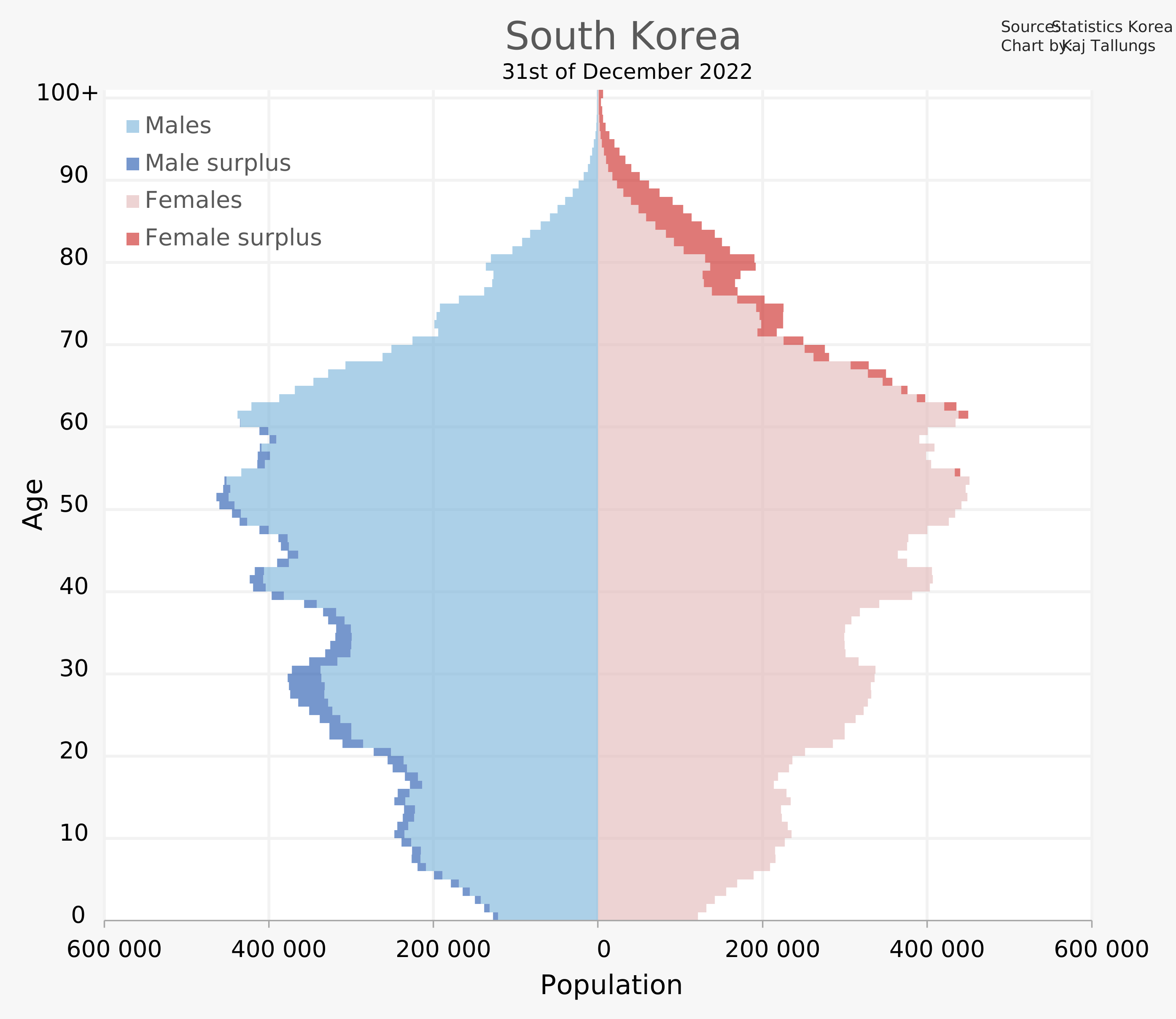

.png)
Before, society grew with the average working age person only needing to half support an elderly retiree. Now, that same working age person will need to support more than 2 elderly retirees themselves, over 4 times the resources.
Has it occurred to people that, maybe, modern fertility is a tragedy of the commons? If everyone chooses to act in their own interest, society is worse off than collectively pressuring to have more kids? Ideally, that would look like major subsidies and benefits to parents to account for the extra work they are doing for society.
I fear if nothing else changes, developed countries are dysgenically wiping themselves off the planet, and the traditionally oppressive-to-women societies will evolutionarily outlast us.
At this rate, there will only be 3m South Koreans in 3 generations. I don't see how you expect a country to survive that decline. In 1960, Pakistan had 45m people compared to South Korea's 25m. Now, Pakistan is forecasted to reach 450m in our lifetime as South Korea implodes. That looks like our future.