That makes no sense whatsoever; fuel cell mass scales with power output, not with system capacity. Extra capacity incurs just slightly bigger tanks. No serious study I've seen assumes that long-duration storage (~100h or more) has fuel cells heavier than batteries. The last paper I've seen had batteries twice as heavy as the whole fuel cell system. I may try to find it again.
You need a part of the system anyway so you can't count those parts (water tanks, hydrogen tanks, oxygen tanks, electrolyzer) into any of the power options. They will be there regardless of whether you want them or not.
Also I've noticed that despite of what ben_w claims the article says, the article still assumes 100 kWh/t for a battery system and 1 MWh/t for a fuel cell system. So it doesn't really say that "the dry mass of the fuel cells would mass similar to LiIon of the same energy storage capacity", otherwise the numbers would be in the opposite order.
Right next to where it suggests 1 MWh/t “For the sake of argument”, it says:
"""Even using Lunar water, the mass of the cells, condensers, electrolysers, power electronics, storage tanks, and heat exchangers is comparable a Lithium-ion battery, while the round trip efficiency is much lower. And that’s not even including the mass overhead for mining lunar water!"""
Yes, but that makes no sense. Partly because as I said, lots of those components will be mandatory anyway so they should count into the fuel cell system at best only partially, and partly because pretty much the only part that scales with capacity is the tanks anyway. The rest scales overwhelmingly with average power instead.
Due to shipping and redundancy concerns redundant tanks are used to expand storage. So, the dry mass of tanks should scale nearly linearly with the total amount of water, hydrogen, and air stored.
Nobody said they don't. But 1) that doesn't make the fuel cells bigger (so the "similar dry mass of the fuel cells to batteries of a given capacity" is a category error), and 2) the additional tank mass is very mild. We can for example store 20.8 tonnes of hydrogen/oxygen mixture in a ~2 tonne tank. We know this because the Centaur stage does it. And those two tonnes of tankage correspond to ~50 MWh of electricity generated by a fuel cell. That's almost 300 tonnes worth of batteries in the form of 23 tonnes of mass, 21 of which might even not need transportation from Earth. Potentially up to a 100:1 win for Team Fuel Cells! ("Only" ~10:1 if you do carry water from Earth, but that's still substantial.)
Sure, dry mass of fuel cells vs dry mass for fuel cells vs total mass need for fuel cells.
Also, that’s just the start. Team fuel cells are also dramatically lower efficiency so you need a extra solar panels and all the associated equipment with that. Which again scales linearly with energy demands.
For non tracking panels at 100% efficiency and 200W/kg assuming an optimistic 1/2 of total weight for solar collection is panels runs around 50 kg per MWh per month on the moon.
Batteries at ~90% bump that to 55kg/MWH. Fuel cells at ~30% bump that to ~170 kg or another 110kg /MWh, not that significant but still important.
How does panel efficiency go into this? Those 200 W/kg are post-conversion, so whatever efficiency they have is already included.
> assuming an optimistic 1/2 of total weight for solar collection is panels
What does that even mean? 200 W/kg is system efficiency, so not just cells but all the structures involved.
> runs around 50 kg per MWh per month on the moon.
I don't get it. "MWh per month" is 114 watts. A 50 kg array at 200 W/kg has 10 kW peak. At the south pole, a non-tracking unifacial horizontally mounted and elevated array will have at least a ~30% capacity factor, a bifacial array will have a ~60% capacity factor. That's 3 kW or 6 kW on average, respectively, far from your 114 watts.
EDIT: Should have really been 1.4 kW instead of 114 watts - I calculated with 1 MWh per year by a mistake. Still a substantial difference from 3/6 kWh.
> Fuel cells at ~30%
A round-trip from a fuel-cell system will be at ~40%. Maybe ~50% if you use top equipment. But even bog-standard fuel cells are at ~50-55% (LHV) efficiency and bog-standard PEM electrolyzers are at ~80% efficiency, which should give you no less than a 40% round-trip.
It doesn’t but a measure of output from solar panels ignores the storage efficiency which is what we care about here.
> 200w/kg is system efficiency.
You listed that as the panels in your post.
First actual array output falls over time. Whatever it would be new is irrelevant you scale for how long it’s in use. Panels on the moon need to be mounted at an appropriate angle for maximum efficiency, cooling, they need wires to move electric from the panel to your power conversion, electronics to handle that power etc. You also get losses from lunar dust, etc. Simply saying all that doubles weight is a reasonable ballpark.
Don’t forget the moon is dealing with days of full sun panels need to maintain low temperatures for efficiency and you can’t just dump all that heat into the moon.
> I don’t get it
A 50kg array consisting of 25kg of solar panels, at 30% efficiency produces: 25 different 0.2kw panels for 30 percent of the time over 28 days times 24 hours = 25 * 0.200kw * 0.30 * 28 * 24h = 1008 kWh or 1.008 MWh.
Edit: 1.4kW * 28 days * 24h/day = 940 kWh or 0.94 MWh.
> A round-trip from a fuel-cell system will be at ~40%.
I have yet to read about an actual working system over 30% water to hydrogen to water. Do you have any citations or is this assuming some unknown breakthrough?
> It doesn’t but a measure of output from solar panels ignores the storage efficiency which is what we care about here.
So why even mention panel efficiency?
> First actual array output falls over time
You always compensate for it, it's not hard.
> Panels on the moon need to be mounted at an appropriate angle for maximum efficiency, cooling, they need wires to move electric from the panel to your power conversion
All included in that figure.
> electronics to handle that power
That is admittedly not included in that figure but PPUs are still fairly lightweight these days.
> Don’t forget the moon is dealing with days of full sun panels need to maintain low temperatures for efficiency
We've already dealt with these things for geostationary satellites, and those are almost always insolated thanks to their orbit.
> and you can’t just dump all that heat into the moon
On the south pole you most likely can, since even though there's lots of sunlight, the extreme incidence angle means that the surface is disproportionately cool.
> A 50kg array consisting of 25kg of solar panels, at 30% efficiency produces: 25 different 0.2kw panels for 30 percent of the time over 28 days times 24 hours = 25 * 0.200kw * 0.30 * 28 * 24h = 1008 kWh or 1.008 MWh.
Heh? A 50 kg array at 200 W/kg produces 10 kW peak and even at 30% capacity factor generates ~2 MWh in a lunar month: 100.324*29.5 = 2.124 MWh.
> consisting of 25kg of solar panels
I already said that the ~200 W/kg for UltraFlex/MegaFlex arrays includes structures, so there's no "25kg of solar panels". There are in fact no panels at all - on UltraFlex/MegaFlex, individual "naked" cells are attached to the flexible substrate of the array directly.
> I have yet to read about an actual working system over 30% water to hydrogen to water. Do you have any citations or is this assuming some unknown breakthrough?
No, it assumes perfectly standard system components. But here you have NASA's RFC demonstrating 50% efficiency in 2006 (already fifteen years ago!): https://ntrs.nasa.gov/citations/20060008706
Those fit on satellites in zero g. The moon has gravity so you support them at an angle you need bracing on something else, or for extra long panels connected to a structure you need bracing inside these ultra flex panels.
In space panels can radiate from their back sides into space, but that doesn’t work on the moon as it hits 260 degrees Fahrenheit in the day. Look up panel efficiency curves with temperature. Cooling during the day is a major concern for a long term lunar base, but also needed for panels.
Further you need cables from wherever they are to where up your using power.
Lunar dust again is an issue for solar panels on the moon vs satellites.
Sure, and that worked wonderfully a lab. But, production systems need to worry about a great deal of stuff that doesn’t apply in a lab setting. I don’t mean this dismissively yes I completely agree in theory it could work, but it’s just not working technology yet. I haven’t looked recently so hopefully there is a system demonstration out there.
>Those fit on satellites in zero g. The moon has gravity so you support them at an angle you need bracing on something else
UltraFlex/MegaFlex is rated for 3g acceleration on those satellites even when fanned out, why do you think it would have problems with 0.16g? That's one twentieth of what they're supposed to withstand.
>but that doesn’t work on the moon as it hits 260 degrees Fahrenheit in the day
> Further you need cables from wherever they are to where up your using power.
High-voltage cables are not that heavy.
> Sure, and that worked wonderfully a lab. But, production systems need to worry about a great deal of stuff that doesn’t apply in a lab setting. I don’t mean this dismissively yes I completely agree in theory it could work, but it’s just not working technology yet.
Of course you don't; you're just disingenuously moving the goalposts.
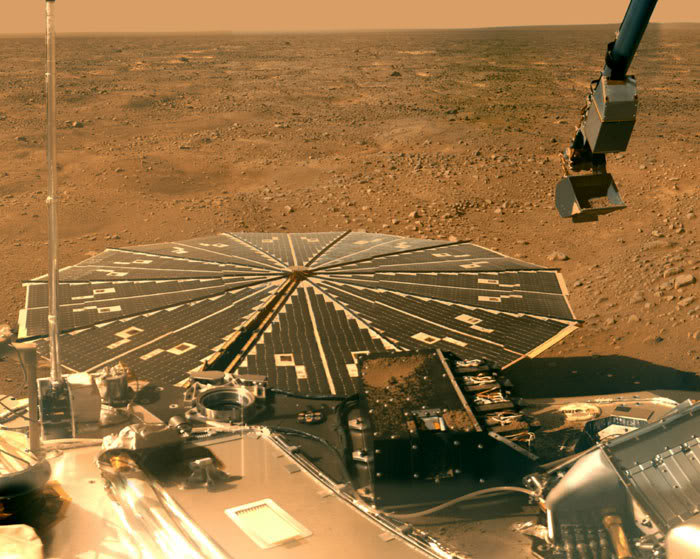
The actual panel on Mars isn’t flat or particularly big. Now, if we’re assuming the Moon mission is going to be at it’s equator then laying them directly on the lunar surface is fine. But big arrays at an angle need to be rigid or you’re losing poster from a using a worse angle due to the curve, either option means more weight for a given power output.
> That's just not the case on the Lunar south pole
Sure, and that deals with heat but now the solar array needs to deal with being at the poles.
This is an absolutely meaningless level of deformation. The array will be perfectly fine in Lunar gravity. And even if it weren't, instead of a fan, you could equally well shape it into a folded vertical curtain hanging from a beam with pretty much the same parameters.
> Sure, and that deals with heat but now the solar array needs to deal with being at the poles.
"Now"? It needed to deal with being at the pole the whole time. There was never an intention to put it elsewhere.
> you could equally shape it into a folded vertical curtain from a beam with pretty much the same parameters.
Attaching a beam at one end requires a more rigid structure which is more weight, which is exactly what I said the problem was several times.
> There never was an intention to put it elsewhere.
I just said you could lower weight by laying them flat at the equator. My point was simply that isn’t an option, therefore you they need extra support. Operating closer to the poles has both clear advantages and downsides, access to water is a big benefit but it’s not quite as obvious a choice as often assumed.
> Attaching a beam at one end requires a more rigid structure which is more weight
Not really because that allows you to omit other parts of the original self-supporting "fanned" structure which formerly had a similar role to that beam. Furthermore you wouldn't be building this structure to withstand 3g like the "stock" UltraFlex/MegaFlex arrays but you'd build it specifically to withstand static 0.16g in one axis for deploying after landing on the Moon. Consequently I very strongly doubt that this would give it "more weight" than the current UltraFlex/MegaFlex arrays already have because you're assuming more weight for a flimsier structure and that just doesn't make any sense, unless you'd assume the use of inferior materials for some reason.
That fanned structure is very strong. For a one dimensional example consider an I-beam supported at the center vs having that same I-beam attached only at the edge. Which do you think can support more weight?
And again even at Mars’s 0.38g it’s already bending. It can clearly survive more force, but not at an optional solar collection angle. Use the same thing on the moon near the poles and sure it’s not going to break, but it’s also not collecting 200W/kg.