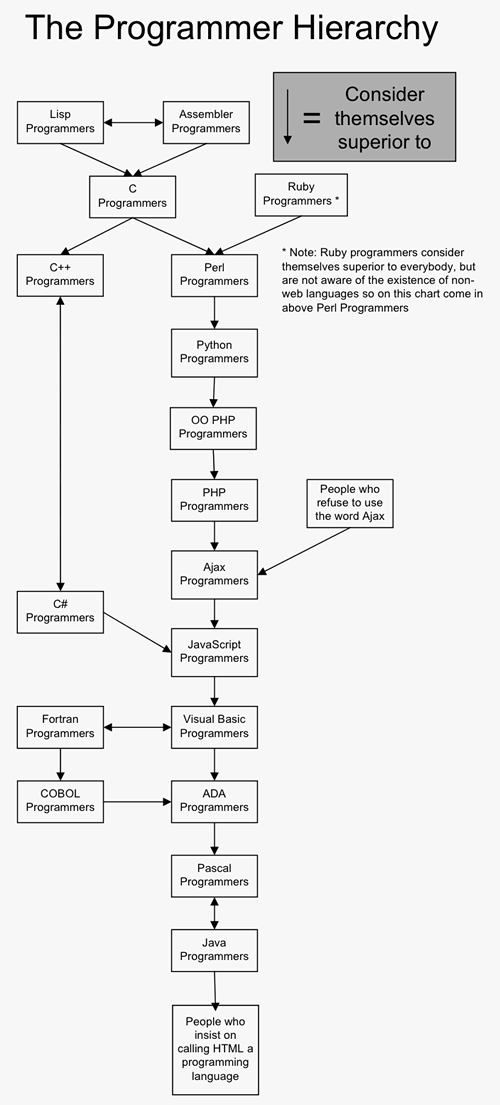
Lisp(and specifically common lisp) is one of the top languages people who don't know it like to criticize. That wouldn't be a bad thing if the criticism was any good. Every time i see a blog post about some "problem" with lisp the chances that it has something valuable to say are low. And calling a language community a cult is beyond offensive.
I want to both upvote you (`` the chances that it has something valuable to say are low'') and downvote (``is beyond offensive'') at the same time.
See, his arguments about Lisp community being a cult stand. Yours are purely emotional.
Now we could agree that there is a very good reason to be cultic about Lisp -- it is the best thing since the sliced bread etc. etc. and people should just use it -- but that's another matter.
In a way, he pre-empted your reaction with ``If such jokes reliably meet with stifling social disapproval, it's a cult.'' ;-)
I absolutely love Lisp, but I'm not in the least bit offended at someone describing some aspects of the culture as cultish.
But the thing is.. the very same thing could be said of most other language enthusiasts.
Look at all the endless hype from Python and Ruby fans (especially when they compare their favorite language to Perl).
Or look at some OCaml or Haskell fanboys and their attitude that static typing is The True Way and only ignorant savages would prefer a dynamically typed language.
And this doesn't even touch on the vi vs Emacs holy wars.
There's plenty of fanboyishness, exclusivity, and and chastisement of outsiders in many computer fields. And I dare say it's not really limited to computers either. I'm not sure if "cultish" is really the most appropriate term, but I feel no offense at it.
don't get me wrong, i like lisp a lot. but i think lisp has a bad image because many lispers (not all) are nitpickers. lisper think they are cool, but they are not. they don't let anything new in their language. they stick to s-expressions like they are the holy grail. they stick to the funny function names as if they were given by god. they are the most conservative language community (maybe apart from COBOL). look at all the disregard they had for arc. this could have been a beginning to dust off the fossil language and remove all the warts. but they did not like it. instead lisp is still the language that it was 50 years ago. <\rant>
You seem to misunderstand lisp programmers greatly, allow me to attempt to exlain:
they don't let anything new in their language.
Common Lisp is a standard, changing it requires tremendous resources, and provide little actual value, if you have some language extension you want added to the language, put it in a library, it will be much cheaper and much more useful that way.
they stick to s-expressions like they are the holy grail.
We stick to s-expressions because they provide tremendous value. They are just more useful than traditional syntax.
they stick to the funny function names as if they were given by god.
Common lisp has over a thousand symbols, and only a handful of them i would consider funny, and you are complaining about them? And you accuse us of nitpicking?
The rest of your rant is more of the same bullshit. How can you say you like lisp, and then continue to talk uninformed ignorant bullshit?
> instead lisp is still the language that it was 50 years ago.
I beg you to differ. The original, McCarthy Lisp was a succinct, powerful, flexible, dynamic language based on a small set of axioms.
Through times, a lot has been thrown out for sake of performance (which was understood to require compilation). Um, well, in case of Lisp, it means a lot of cruft has been added (some say, bolted onto) -- the simplicity etc.etc. was lost. Those days functions aren't even lists anymore, and scoping is lexical!
With a few notable exceptions. Which are either hold-outs, or back-to-the-roots/back-to-what-worked-better efforts.
Arc is closer to the original Lisp. Also, is more pleasing to use. Not a coincidence.
People keep saying that but i don't get it. Can you give me an example of the cruft you are talking about? Its one of those other myths i keep hearing about our cult.
p.s. Arc is more pleasing to use to you, I would certainly not choose it over common lisp or clojure, but maybe over scheme.
yes the first step in the right direction. now give us (maybe optional) infix notation and get rid of the parenthesis (also optional). this could gain some momentum in the mainstream (but then lisp (or its successor (clojure++)) would no longer be the elitist language oh my!)
Simple syntax isn't about elitism. It's not like some evil Lisper, decades ago, figured ``I know! let's make simple syntax so almost nobody can understand or write it!''
The simple syntax of Lisp has only one purpose: easy programmatic manipulation (reading, writing, transformation). I.e., less boilerplate. Let me spell that out for you: EASIER MANIPULATION, LESS BOILERPLATE. Elitist much?
There isn't Yet Another Parser Toolkit Of The Week in the Lisp world, there isn't Yet Another Lexer Utility Of The Month in the Lisp world.
Seriously, writing a bunch of parentheses isn't much harder than writing intricate, complex C-like (C++, Java etc.) syntax structures. How the heck did simplicity became synonym of elitism in the subject of Lisp syntax?
Taking yourself too seriously and being in a cult are two very different things. I agree that _some_ lisp people(even me at times) do in fact take lisp a tad too seriously, but i can't see how that makes you into a dangerous religious nut.
P.S. Im starting my own lisp cult, called the cult of the mythical lisp cult, our goal will be to find the holly grail of programming language flame wars: evidence of the mythical lisp cult. See, a joke about lisp, and its recursive too :D