What I noticed is a lack of mention of installing elevated solar panels so grasses and other plants can grow under the solar panels where the shade reduces the impact of too strong a sunlight exposure.
"The paper suggests it was mostly due to significantly increased water efficiency – 328%. This efficiency allows semi-arid regions, with a wet winter, to store more water in the ground, allowing for a longer growth during the growing season."
On my own lawn, the shaded areas stay green all summer, the full sun areas turn brown and into dust. I gave up watering the lawn years ago due to endless problems with the sprinklers. (Everything from them simply getting smashed by foot traffic to freeze damage to getting chewed to bits by coyotes.)
I've had similar problems with sunny areas and tried watering more. It helped a little. Then one year I tried fertilizing (manure + miracle grow) and my lawn turned completely green, even the full sun areas.
The idea of using water via a sprinkler system to keep a lawn green is such an alien concept to most people. Maybe California have a water problem for a reason?
well, there's a lot of value in ground cover. Now, a conversation about moving to native plants instead of grass everywhere would probably be worth having.
Using water during a water crisis so you can have a green patch next to your driveway is the most excessive American thing I've heard today (a worthy winner in such a competitive field)
Its eye-opening to see how little understanding of American living conditions are overseas despite the pervasive distribution of American media.
My 'patch' of grass here in Texas is thousands of square feet. The lot my house site on is .33 of an acre, which in metric is 1335 square meters. The house itself is ~3200 sq. feet (306 sq. meters) over 2 stories so the foundation is roughly 1/2 that so you can extrapolate that is a crap-ton of area left for our patch of grass.
This is in no way unusual or extravagant for the suburb I live in and provides lots of enjoyment for our 2 dogs and 6 kids.
Because everyone else has it doesn't stop it from being excessive and wasting water. In California we are seeing more and more people switching to drought tolerant landscaping.
Our part of Texas has overfilling dams and our particular town has enough excess water that neighboring municipalities are buying our unused rights from us.
Our Texas adapted grass goes dormant half of the year as well so the actual consumption is relatively minimal.
Our water use is fractional of a traditional manicured English garden.
While the concept of using perfectly potable water to water a lawn is a little bass-ackwards, people do do it here. I personally don't, my lawn goes dormant in the heat of summer and that's ok too.
In Wisconsin we rarely need to water a mature lawn. If you're going for close cut and perfectly green you might need to, but on average it's not needed.
I think this is a really interesting point, and am curious about how the shade from the panels will change the ecosystem underneath them. If the natural habitat is mostly low brush having soil that is fully shaded for a large fraction of the day would advantage different types of plants.
I suspect they haven’t thought about what this will do to the topsoil.
Even ignoring the ecological catastrophe of destroying the topsoil, getting the dust it produces off those panels during the summer is going to be expensive.
Planting native pollinator friendly stuff under the solar panels would address my concerns though.
Are you under the impression farmland is not a massive source of dust? It's tilled and aerated soil populated by short-lived crops genetically engineered to spend as much of their energy on the edible part as possible.
If you want a concern to hold, it's that this will probably increase pioneer grass spreading during the rainy season and then then the panels will all get melted in a wildfire. You don't need to plant anything to pollinator-friendly stuff on your land in California. It shows up with a vengeance.
Also, if not controlled, Avena grass (the invasive species that turns the hills yellow during the summer) takes over, killing off anything that would support pollinators during the summer and fall.
The cracked soil is a feature of being a desert, and since the entire point of this is that it's unsustainable to irrigate a desert that far from a major waterway, there isn't much to be done in the long term about what species thrive. That's the wages of climate change.
I'm quite aware of how much food California produces. I'm also quite comfortable with California not overfarming and just, you know, letting the rest of the country stop producing subsidized corn.
I can't help but feel like it's a subtle contradiction to propose that without constant watering the soil in California will crack up and vanish and that's not going to happen with crop rotation but will happen with crop rotation (as if many farms in California aren't already forced to do this because of the nature of our groundwater).
Are you also opposed to orchards? They're full of solar panels that make fruit rather than electricity.
An answer, then, is to plant some longer-term grass (or something that can hold the topsoil), and give the panels a short spray of water every morning to remove dust.
Increases efficiency, prevents undesired pollinators taking control of neighboring paddocks, uses an order of magnitude less water than actual crop irrigation.
I'm fairly sure the pollinators are a benefit, even if we're going to have to accept much more aggressive and dangerous varieties populating the state as the average temperature rises and ongoing insect migrations continue.
>getting the dust it produces off those panels during the summer is going to be expensive.
We're talking like a couple minimum wage employees with leaf blowers and ladders. Sure it doesn't cost nothing but in the context of a commercial operation it's not thaaaat expensive.
Vegetation management is an ongoing task for solar farms. Herbicides can be used to keep weeds and vines from growing on the panels, and grasses should be mowed to keep down pollen which dusts the panels and reduces efficiency.
Soil salinity is a serious issue in the central valley of California [1]. Converting more of that land (often currently fallow) to solar is an interesting solution to the problem.
Specifically groundwater use with poor drainage leads to salt accumulation over time as the water evaporates and the trace amounts of salt present in the "fresh" water are left behind.
The central valley accounts for 1% of US farmland by area and 8% of US agriculture by revenue. Whatever they're doing wrong, they're also doing something right.
What they're doing is raising exotic cash crops instead of huge fields corn and soybeans. The climate allows them to grow crops that would not survive midwestern winters, like almonds.
That scene is quite plausible! People have calculated that we could supply all of Earth's (present) energy needs by covering just 1.2% of the Sahara desert in solar panels [1], and there would be positive side effects on the local climate to boot. Of course, we would never actually get all our energy in one spot, since there are questions of transmission, redundancy, political instability, etc. But it does point toward a future where lots of otherwise-useless desert land (like in SoCal, where the Blade Runner movies take place) is converted into solar farms.
Not at all! For the last few decades, reductions due to efficiency gains has far outpaced increased demand. For example, we nowadays build much more well-isolated homes which reduces the need for electrical heating in colder climates, and air conditioning in hotter ones. I don't think there is any Western country in which the per capita consumption of electricity has grown significantly over the last 20 years.
Consumer electricity is expensive. In some ways it's good because it drives the economics behind efficiency, but in other ways, it's unfortunate that energy is such a large part of the average American's monthly budget (electricity, oil, natural gas, and gasoline).
Cheap energy is an extraordinary economic driver. Cheap green energy is a double win.
Surely electricity prices have something to do with that, I hope in future energy becomes abundant enough that we can waste it without costing a fortune or destroying the environment. I want my toilet seat warmers and aircon, I want my PC to be as fast as possible and not throttled, I don't want to feel guilty about using a clothes dryer. On the bigger scale imagine what we could do with cheap water desalination and removing dams.
The environment is being destroyed right here and right now.
Are you willing to risk it being destroyed more because you want toilet seat warmers and a clothes dryer?
Still, you can always only go so far with efficiency gains - they are important, but should not be depended on instead of looking for new cheap & clean energy sources.
And there are also some technologies, that while very energy hungry, can help fix many of the pressing world problems (large scale desalination, plasma waste processing, large scale CO2 capture, various benefiting megaprojects, etc.).
Do you have a source that controls for real electricity prices? Coal prices for example have risen faster than inflation over the last few decades (coal ~$30->$88 [0] vs inflation expectation $30->$42 by the US BLS calculator 2003-2019) and the renewables that have been bought online weren't exactly cheap.
There is always going to be a sink for more power, because all else failing electricity can produce more aluminium products, and aluminium is one of those wonder materials that there will always be uses for. We know that energy efficiency can just as easily cause consumption to rise as to fall [1].
Somewhat surprisingly, this doesn't seem to be the case. Your average middle-class person in the west probably uses less today than 30 years ago; all major appliances (particularly lighting and heating) are more efficient, TVs are much more efficient, cars are much more efficient.
World power consumption is going up largely due to a rapidly growing middle class, but within that class, not so much.
However, if we're going carbon-neutral people driving gas cars and using gas to heat their homes may well end up needing electricity for those as well.
So we might expect an increase in per-capita demand for electricity, if not for total power.
The trend towards better energy efficiency has all but stalled increasing energy use per capita in developed nations. And effective efforts at water conservation show that it is possible to pull back consumption in some cases, even if the natural trend is increased consumption.
There is a wide variety of deserts. Some of them have rich, interesting, valuable ecosystems, possibly including the one(s) you lived in. And some of them are most certainly useless.
But still, if we are going to have solar panels somewhere, I'd rather have them in a desert where there is not as much wildlife to disrupt as in, say, a forest or grassland biome. It's not like we're at risk of running out of deserts, either.
(1) Generally this is not good ecological thinking. Disrupting a robust biome like grassland or rainforest is much more difficult than disrupting a fragile one like desert or tundra, and robust biomes recover much faster if you do manage to disrupt them. I think it happens to be correct in this case because the panels will tend to strengthen the biome by providing shade rather than disrupt it.
If you go around disrupting desert biomes on a large scale, you cause desertification, converting the adjacent savanna and forest biomes into semi-arid desert. So even if you don't value desert for itself, that is foolish planning, unless your aim is to harm wildlife and the humans alike.
(2) We aren't at risk of running out of children, either, but that doesn't excuse neglecting or sacrificing them.
Hardly, the amount of extreme desert vs the amount of people that want to visit is an extreme over supply. On the other hand people actually spend effort growing flowers.
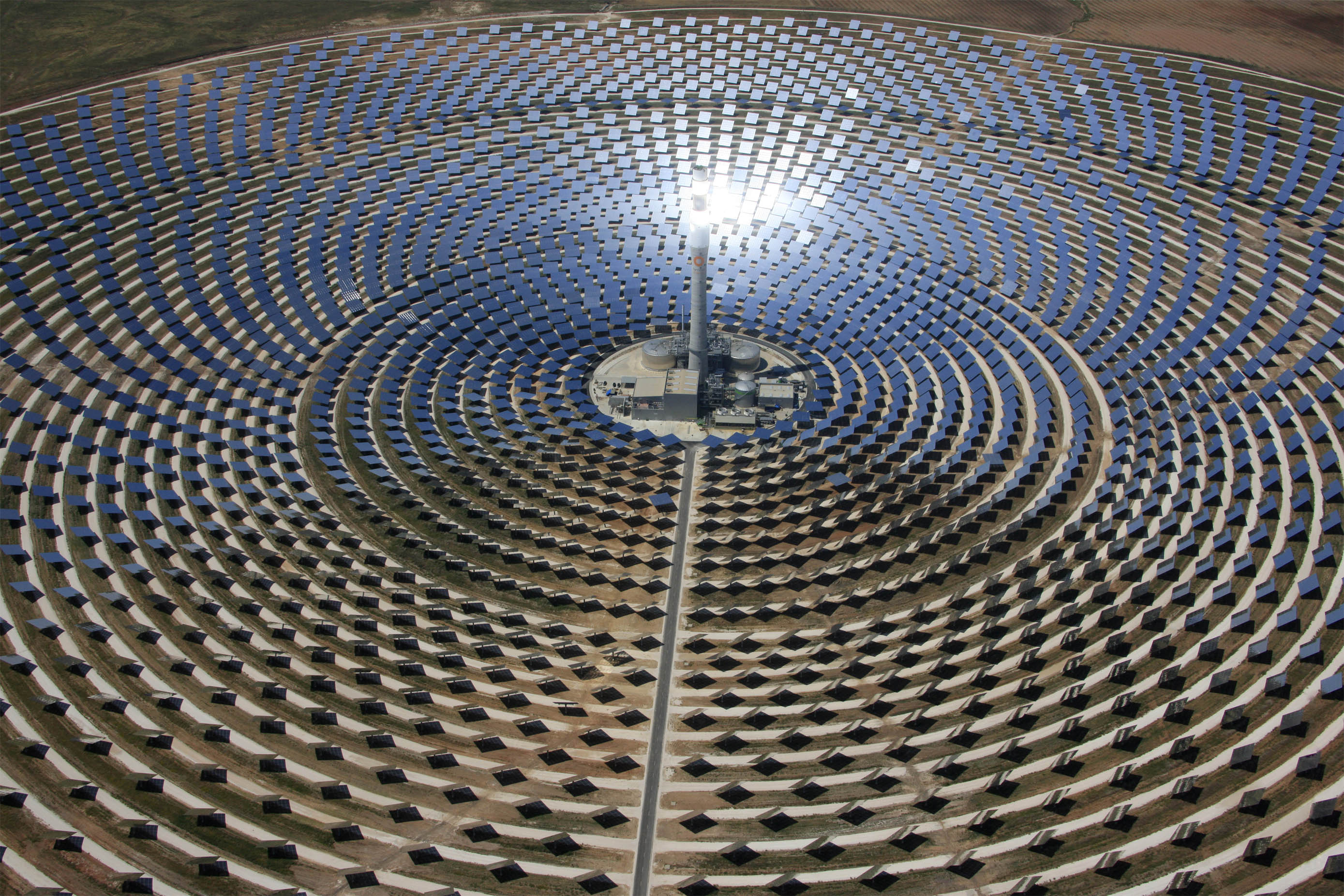
It doesn't seem optimal to put them in a circular formation like that, though. From wherever the sun hits, some panels will be hit from the side and the light will miss the panel completely. It looks cool, but it doesn't seem realistic.
To prevent mirrors shading each other. If you look at the upper part of the photo, it's almost a uniform mirror from this point of view. But if you look at the bottom, there's lots of spaces. The overlap/spacing is likely optional for reaching the tower.
Those are concentration mirror, they reflect light onto the spire in the middle which had a receiving element at the top. Conventially they're used for thermal application where you use the sun to generate steam at the top of the tower, although there has been research into beam down variants where the light is reflected down to a very high efficiency PV cell.
Elaborating slightly, this works because some types of solar panels can be overloaded by several orders of magnitude so long as the panel temperature is kept low enough.
I think a dyson sphere would be great more for helping us prevent global warming than generating cost efficient electricity. Opening and closing the dyson sphere to control radiation flux would be a cool thing. We'd have planetary AC
Non-water consuming income stream, which also rests the land. Minor worries about erosion and soil health, but feels like a net beneficial model overall.
Same problem in Australia. Massive groundwater and surface water problems, with a power issue around coal. If we paid farmers to take land out of direct production or to reduced intensity, (income stream) and therefore reduce water consumption (groundwater restored) and rest land (reduced soil erosion) its a big upside.
And thats two economies, California and Australia. You think there are no other places facing tensions around land use, water and farmer income?
Unfortunately the Australian government is still in the pocket of the coal companies, so these efforts have to come from private donation and face government pushback. Australia has incredible solar and wind power opportunities that the current government is trying their best to ignore in favor of burning more coal.
Remember that time you somehow managed to hook TiVos together to a video camera so it created a psychedelic looped stream of the present? I'll never forget that one... Derek
Modern panels are wired so that they're not quite so devastated by having an edge of the panel occluded. You can observe this with newer folding panels as well; they're often wired such that only a half or quarter of the panel being exposed leads to a linear reduction in output as opposed to a catastrophic failure.
Besides, it's not like farming is human-labor free. It's certainly comparable human labor to imagine keeping solar panels relatively dust free compared to growing strawberries.
You can clean them with electrostatic force. Also, you can jut flip the panel over. You definitely don't need to use water regularly and you certainly don't need it to be anything but within a reasonable PH.
I discovered that compressed air works great for cleaning my car interior. Have to be careful to hold your breath, though, don't want to breath in the gunk.
I have seen many stories about large solar panel installations but I have not seen very many stories about energy storage systems. Solar energy is dependent on weather, season, and time of day so energy needs to be stored for when there is less to no sunlight. I know Tesla has done several large battery installations but has anyone seen any other stories?
I know there are ways to store renewable energy. I am asking about specific energy storage sites being built. Generally speaking, linking to search results is condescending and not an answer.
Trade publications like Greentech Media and PV Magazine are currently the best option if you want to keep up with electricity storage news. As the storage market matures somebody will probably launch storage-specific publications, just like solar and wind already have their own specific trade publications. Here are some stories from the past few months:
Is there any reason solar installation could not be vertical like a tree with branches and leaves? Is there no angle / arrangement at which efficiency is all the same as a flat set up? Or is it just more expensive to build out that type of infrastructure?
Trees only do what they do because they're in competition with other trees. Unless someone starts putting solar panels on poles above the farm, it doesn't really make sense to kick that kind of competition off. There is, after all, a fixed amount of surface area to expose to direct sunlight.
I’ve seen those, they are interesting but not exactly what I had in mind in terms of form. I envision some sort of square set up at 45 degrees angles for each panel, aimed inward like a funnel, but now I’m thinking it’ll probably destroy itself with all that heat generated?
not sure of the details but heard that the chinese govt is incentivizing rice farmers to install solar aerators and convert the rice paddies to fish ponds
(and this may be as part of a hybrid fish/rice farm with nitrogen exchange)
It was probably from that stack exchange answer about China a couple weeks ago, about converting traditional fish ponds that used waste from silk worms? to a method using solar panels.
Albeit much smaller area, I see this a lot around Rhode Island. They are taking farms and woodlands and turning them into dusty dirt fields with just panels, its a sad state of affairs.
I would love to see laws preventing destruction of woods, or otherwise fertile land, especially when wind power seems to be the way to go around here.
I've seen a lot of solar panel installations around Massachusetts highways. It seems they got put up on otherwise unused open areas around the roads, such as clearings between the shoulder and the woods, or the area inside the clover leaf ramps. [1]
We have seen this in many places in Japan - otherwise unused spaces around railway corridors, factories even seafront now host solar panel installations.
That is a much better use of space, although I'm concerned that any shiny object near a roadway needs to be carefully aimed not to blind drivers (there is a certain gold-windowed building on 95/128 that comes to mind...)
I do recall seeing more parking lots being fitted with a solar roof, and vehicle charging below...this probably should be the primary use of panels, shading otherwise blacktop parking lots
About aiming… solar panels want to be installed normal to the sun which means any reflection is going to go back toward the sun. Of course the sun moves around but the reflections are mostly sunward. You’d probably have to have panels in a steep valley to reflect back toward a road.
I live in the bay area atmospheric river and I still get a ton of juice out of my solar panels. I definitely have down seasons and the local laws with respect to off-grid power are frustrating, but I don't regret it.
You might say, "You have not recouped the cost." This is difficult to measure; my home has power during power outages. We have them regularly around here. What is the price on having uninterrupted power in your home when no one else can deliver it? Surely quite high, by comparison, no?
The red area in the map is the most productive part for Solar and Orange is partially good.
Solar is very geographically dependent, also high altitude is good, that is why Tibet/Colorado is in dark red. Precipitation is a problem for Solar, that is why Florida is OK but not great place for it.
People are actually cutting down trees to put up solar farms? Do you have a citation for this? If it's unprofitable farmland that doesn't need development that's one thing, but I can't picture a utility actually clearing out a forest just to put solar panels up, that seems a tremendous waste of resources when there's so much open land elsewhere in the US.
There are no articles written about it, usually it's simply driving around and suddenly seeing a field where there were woods.
If you want to find historical satellite images, one area is on Plains Road near URI. Ironically, it is across the street from URI's empty turf fields (although they do use that for research)
Is it silly? You'd have to calculate the amount of CO2 sequestered by the destroyed woodland vs the amount output over time by whatever fossil fuel power generation could be replaced by the solar panels. I certainly don't know off the top of my head. Of course it would make much more sense to use already cleared land still - but maybe uncleared forest is much cheaper or something.
Im having a hard time figuring out what people thought was going to happen with renewable energy other than destroying woodlands and other open space to collect energy.
I don’t think anyone heard “let’s use renewable energy” and immediately thought “of course that means cutting down a bunch of trees”.
If you did, I’d love to hear why this is such an inevitable consequence that it’s worth pointing out how inevitable it is as opposed to putting solar panels literally anywhere else that doesn’t have trees.
It's certainly the nature of the culture we inherited. You can look at alternative cultures folks have maintained where they don't spread out as rapidly as possible and have some base notion of conservation and environmentalism and it seems like those folks have a pretty good situation too.
Ever consider re-prioritizing and leading by example?
> What about understanding how the world works makes me automatically part of the problem?
Pretend, for just a moment, that my proposition was true (as I obviously believe it to be). In that case, you've identified yourself as part of the problem. Especially so because you suggest that your prioritization is inevitable and therefore must be assumed.
> I do disagree that there are other cultures with a 'better' notion.
We can look at the development patterns of some other nations. Not all are so spread out, and not all believe that environmentalism is pointless.
> Culture matters, but nkt that much in the long run when theres status at stake
> Especially so because you suggest that your prioritization is inevitable and therefore must be assumed.
My friend I can guarantee you that despite what I do I will not change the prioritization of half a billion people. An individuals inability or past history of not doing something does not make him or her culpable of supporting the system. By your own measure you too fully support the system I am criticizing.
> We can look at the development patterns of some other nations. Not all are so spread out, and not all believe that environmentalism is pointless
Other nations that have developed in the presence and utilising the products of many other nations that do not share their beliefs.
> There's lots of ways to get status
And yet none of such import on the world stage that you can name it
> And yet none of such import on the world stage that you can name it
You're demanding that an alternative value system have value to you BEFORE you will consider it. This is not very realistic or sensible for obvious reasons.
You're also suggesting your socialization is an inevitable product of human nature. Evolutionary Psychology has been split down the middle on this subject for some time,so I'm skeptical that you can resolve the debate that actual experts can't.
Well wind has a much smaller footprint, and can at least be embedded within the woods without razing the whole thing. The three main issues it seems are visibility, flashing shadows, and the lack of wind
That's not what i meant. I am mainly shocked at the publics general failure to understand human nature and its desire to extract money when incentivized to do so. I dont disagree that wind can have a lower footprint in terms of landspace taken but if solar is more efficient and less expensive then at some point when it becomes long enough lasting to be profitable, then of course those with forests will convert them to solar farms. This was not unforeseeable
You don't even need the solar panels themselves in order to see the effects of perverse incentives. The Kyoto Protocol defines "bioenergy" (energy produced by burning wood) as carbon neutral. As a result, in the EU, they're literally burning up forests for energy, under the banner of environmentalism.
Large wind turbines are much less sustainable and higher maintenance. They're really only sensible in small scales, where their other disadvantages go away, or when no other option is viable.
So, instead of building a few reservoirs (or just covering the aqueducts!!!), California is going to convert irreplaceable crop land to solar farms that could be put on top of much less scarce / valuable land. (eg: desert in New Mexico, the Salton Sea, etc).
You have this curious idea that "a few reservoirs" are going to preserve the usability of this land for farming?
You're just wrong. Climate change is going to make certain parts of California much more expensive (in terms of energy and water) to farm. These areas are probably irreparable, not irreplaceable.
P.S., The Salton Sea is not a place we should send humans to work. It's an industrial disaster, not a resource.
Yes, and the maximum precipitation increase will actually decrease the amount of water that land will hold in topsoil, as has been Southern California's condition for some time.