> And... it's fine? Am I only using the happy path? Or are people just particularly confident about complaining about Tahoe after seeing everyone else do it.
That's like asking whether Jackson Pollock or Thomas Kinkade is the better artist. There is no objective measure for it. Some people will have a strong preference, others won't have a preference at all. The designers who made the changes in Tahoe clearly thought the changes are improvements. A lot of macOS users disagree, but some macOS users don't have a preference.
> The central view of ape coding proponents was that software engineered by AIs did not match the reliability of software engineered by humans
That's not the reason to do ape coding. AI generated code is not innovative. If you want to build something that no one has built anything similar to then you have to ape code.
That's just not true. It's like saying compiled code couldn't be innovative, that the only innovative code is assembly. People used to say stuff like that too, in their fear of being replaced. There's nothing new under the sun, I guess [double entendre].
When Google AdWords first launched its text ads appeared only on the right-hand side of the Google search results page, separate from the main organic listings. See screenshot below. I expect ChatGPT ads will be similar. Ads won't be incorporated into the chat responses.
> 1995-2000 Microsoft's user interfaces were quite tasteful
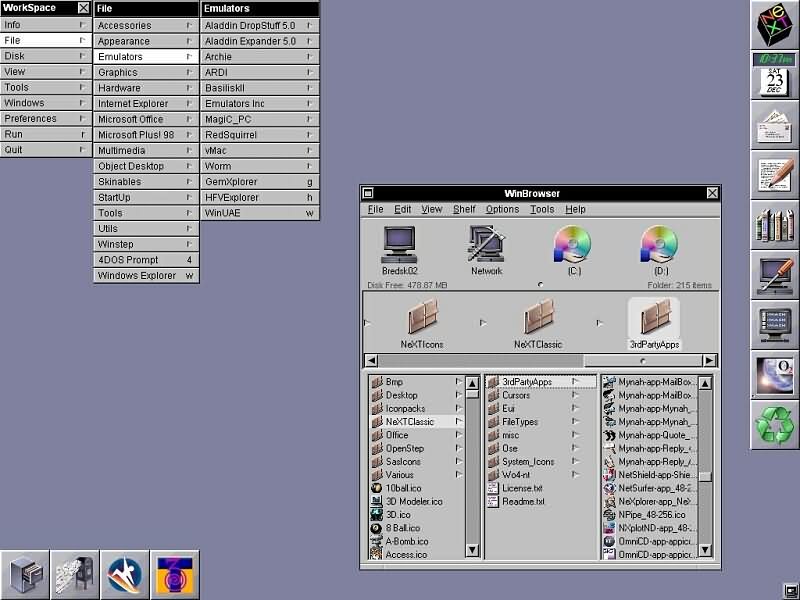
Only because they copied NeXTSTEP. Those 3D beveled controls originated in NeXTSTSP. In Windows, ctl3d.dll added raised and sunken 3D-looking buttons, beveled text boxes, group boxes with depth, a light-source illusion using highlight and shadow, all copied from NeXTSTEP.
please recall that 8bit color was the common capability for CRT displays at that time. Simple one bit display was also common. Any smooth transitions in gray or color had to use dithering, or be very clever in the way they chose the palate.
Certainly some historic credit goes to Motif, but, there are "levels to this game" .. Motif did not jump out as "wow that looks good" IMHO. Obviously NeXT was extreme in a different way.. sort of like a symphony orchestra more than an office machine.
It is genuinely entertaining to see people defend the dull and pedestrian UI in Windows 95.
Motif was also 3D, but the actual look of Windows 95/NT 4.0 clearly took some inspiration from NeXTSTEP and OPENSTEP, for example the window decorations.
I accept that's possible - if not likely (and everyone steals from each other!) - but even-so it only amounts to to the gunmetal-grey default colours and use of a 1px bevel/inset effect; because NS and NT3/NT4's UX/UI design and concepts are just so different otherwise.
...but I'm not personally convinced: instead, consider the demonstrable fact that similar engineering teams, working on similar problems, will independently come to substantially similar solutions; my favourite example to point to is how eerily-similar the Eurofighter Typhoon, Saab Gripen, and Dassault Rafale all look - even entirely indistinguishable at an air-show in-person - despite having zero shared pedigree - therefore it's possible that - given the constraints of desktop graphics hardware of the late-1980s/early-1990s - that a user-friendly desktop UI built around the concept of floating application windows - will all be similar in one way or another.
-------
My pet-theory for why that "Windows 95 1px bevel" look is so prevalent is because it suits working with premade UI graphics rasters/bitmaps using indexed-colors: for example, imagine a Windows-style Property Sheet dialog: prior to Windows 95, software would manually draw all of the elements of that dialog directly to the framebuffer (i.e. using unbuffered graphics) which was slow - ugly - and is the cmputer-equivalent of using a lavatory in a cramped bathroom actively undergoing renovations without any drywall/plastering). Even if there was enough vram for double-buffering it's still going to be slow: painting each and every button, checkbox (with the checkmark!) and tab header. So instead, many individual UI graphics elements could be prerendered (at design-time, hopefully by an actual artist), but not as single bitmaps for the entire dialog - but as an indexed color bitmap for each control type, so no slow/expensive draw/painting is required: only a simple blitbit for each checkbox, for example. Using an indexed-color bitmap based on a 4 or 8 colors palette (face, 3D light, 3D dark, transparent/BG; etc) means a single blob only a few hundred bytes in size can represent a chisel-cut bevelled checkbox - while integrating with whatever the user's preferred color scheme is.
----
....of course now we'll just build a UI in Electron, to hell with memory usage or integrating with the user's OS appearance settings. Le sigh.
As mentioned, Windows 95 uses more or less the same window decorations as NeXTSTEP - although with different semantics. What is minimize in NeXTSTEP is maximize in Windows 95 IIRC.
> my favourite example to point to is how eerily-similar the Eurofighter Typhoon, Saab Gripen, and Dassault Rafale all look - even entirely indistinguishable at an air-show in-person - despite having zero shared pedigree
Considering that France/Dassault was initially part of the Eurofighter / European Fighter Aircraft (EFA) project, I'm not sure if that's the best example to make your point.
Designers tend to be less open to feedback than developers. That, I think, helps explain why flat UI persists even though it has shown usability drawbacks. It also helps explain why overall usability feels like it's declining ever year — for instance, macOS Tahoe seems noticeably worse in usability compared to macOS Sequoia. Does anyone think Apple is going to rush out a release that fixes the excessive rounding of window corners? Don't hold your breath.
On the topic of flat design specifically, developers are likely just as culpable. Back when it was just starting to catch on, by my observation some of the quickest to adopt it were solo developers because it's way easier to build a passable looking app with flat UI since that doesn't require any design talent.
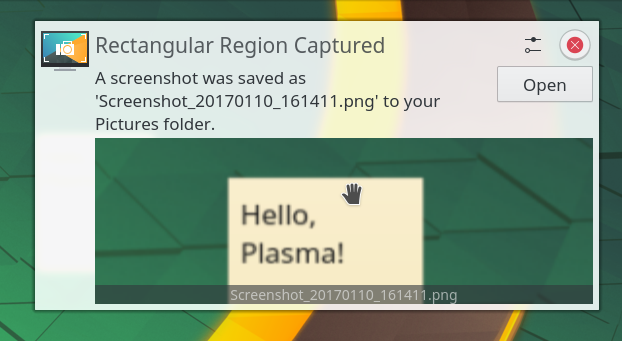
That looks perfectly functional to me? It only looks a bit ugly because the screenshot appears to have been of a very small part of the screen that got blurry when it was blown up to a larger size.
I'll take function over for every day. (I daily drive KDE, it works fine and doesn't get in my way. Most of the time I'm either in my editor or the terminal emulator anyway.)
Once the windows become actually circles, or maybe some point along that path, they'll go back to square corners and congratulate themselves on how much better and innovative they are. It's just a stupid trend to keep rounding things more and more... I hope.
It's all just rearranging deck chairs at this point.
I feel like UX designers don't realize that their job should have a natural tailing off as we discover and lock in the good ideas and discard the bad. Even if the ideas aren't that great, users can at least get good at however it does work, if it stays constant. Instead, we just get more dice rolls, eyecandy, and frustration.
I for one hate the power dynamic that OS and website designers have over me. They can just sneak into my house and rearrange my furniture on a whim. Even if it sucks, I would adapt to it if it stayed constant! Instead I both hate it and can't learn it, because everything is different and keeps changing when I least expect it.
At this point my brain has given into learned helplessness and won't retain much of anything at all, but it's next-level figured out that it's useless.
Designers seem to have a bad track record, and it's getting worse.
Part of the problem is that each generation of designers want to leave their mark on the product - often by undoing the work of the last generation of designers. They're not entirely wrong. Design has fashions, like clothes. I enjoy that the industrial design of laptops and phones changes every few years. But good UX isn't good because its fashionable. Good UX doesn't go out of date. They've gotta learn to stop fixing it when its not broken.
Eg, MacOS's new system preferences panel is worse than the old one. And its stupid putting the windows start menu in the middle of the screen, where you can't as easily click it with the mouse.
I think you might be confusing flat design with UI density. While they emerged as trends during a similar period, they are distinct concepts. You can have small flat elements or large skeuomorphic ones.
I don't think openness to feedback is the main metric, but rather ability to objectively measure outcomes. It's just harder to objectively measure usability than the presence or absence of a bug or performance problem.
>Designers tend to be less open to feedback than developers. That, I think, helps explain why flat UI persists even though it has shown usability drawbacks. It also helps explain why overall usability feels like it's declining ever year
Palm OS does not get enough credit as the progenitor of modern handheld experience, including especially iOS.
iOS shares many similarities with Palm OS, such as the home screen layout of app icons, the use of full-screen apps without windowing, the absence of an explicit "quit" action, no exposed file system (obvious today, but bold back in those days), a single hardware button to return "home", and so on.
What iOS added is true preemptive multitasking, memory protection, multitouch gestures, physics-based scrolling and so on.
React was originally meant to be the 'V' in MVC. You can still use it that way and React becomes very simple when you only use it for UI. Why do data fetching in a React component?
One reason Oracle uses it is because this mode scales horizontally whilst allowing very large transactions. You can just keep adding write masters.
The best implementation of serializable transactions I've seen is in FoundationDB but it comes with serious costs. Transactions are limited in size and duration to a point where many normal database operations are disallowed by the system and require app-layer workarounds (at which point, of course, you lose serializability). And in many cases you do need cluster locks for other purposes anyway.
Probably. I've seen it argued that TX size limits are a good practice anyway, and not having them is a design fault of SQL, but it's an argument on thin ice. Transaction size and scope is usually defined by the nature of the business logic, it's not something you can just define to be whatever you want without consequence. An RDBMS can do atomic and correct changes to an entire very large table without any developer effort. That might hang writes for a few minutes so depending on the nature of your application that might not be a feature you can get away with using, but if the table in question is updated by background workers and not on a latency sensitive path it can be a perfectly viable thing to do (on a good database engine, so not postgres mvcc).
I'll keep my xacts small until that one time we have to do some big manual fix or migration. But you don't even have to do anything that wild to hit the Spanner 100MB limit.



:max_bytes(150000):strip_icc():format(webp)/B1-Snipping-Tool-Windows11-46fbb894a6d04f289a0fdbf3f30c5c63.jpg)
That's like asking whether Jackson Pollock or Thomas Kinkade is the better artist. There is no objective measure for it. Some people will have a strong preference, others won't have a preference at all. The designers who made the changes in Tahoe clearly thought the changes are improvements. A lot of macOS users disagree, but some macOS users don't have a preference.
reply