Agreed, but with one exception: are tests supposed to cover all observable behavior? Usually people are happy with just eliminating large/easy classes of bad (unintended) behavior, otherwise they go for formal verification which is an entirely different ballgame.
No they aren’t because they can’t (at least not without becoming so complicated that there’s no longer a point).
But humans are much better at reasoning about whether a change is going to impact observable behavior than current LLMs are as evidenced by the fact that LLMs require a test suite or something similar to build a working app longer than a few thousand lines.
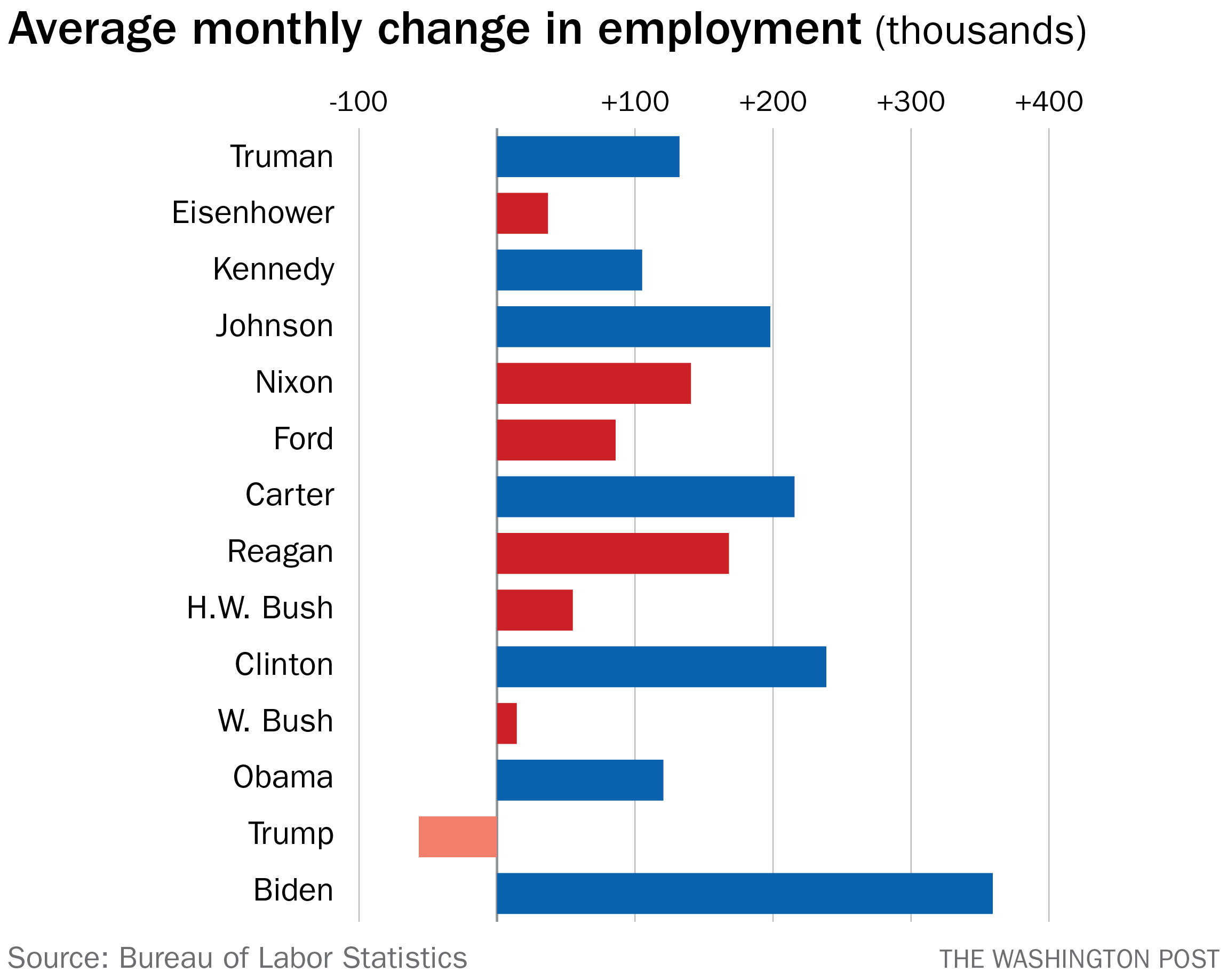
Since the end of WW2, and especially since the end of the Cold War, Democratic administrations have presided over significantly higher job growth than Republican administrations.
This is nonsense even if we calibrate to North America and the EU (versus the American voting public).
Within America, Democrats are center left. Internationally it’s a hodgepodge of left-wing social, centre right-wing foreign and across-the-board economic policy.
It’s fine to say the part is right of your preferences. But it doesn’t help your argument to be delusional about where other Americans stand.
This is why I said DNC. That wasn't just a cool synonym for Democrats. The leadership of the party sits way further right of the average Democratic voter. Someone who is right leaning has more in common with an establishment democrat than the new Conservative-led GOP.
This is also why capital-M Moderate Republicans (who have a near circle overlap with the "Never Trump" movement) are so attractive to Republicans and Democrats alike in purple states.
They're also the only party of fiscal responsibility, although Biden broke the pattern there. Nearly all deficit reduction over the past couple generations has happened under Democrats.
Even with Biden, the pandemic situation was handled relatively well compared to most of the world. We were due for a "soft landing", and then we voted to instead tax ourselves with tsrriffs and scare off the lion's share of our tourism. Oh, and give tax cuts to billionaires, of course.
This is misleading between Trump and Biden, 2020 saw huge employment cuts and Biden gets all of the positive growth of the recovery. Jobs #s actually grew quite considerably 2016-2019.
He's omitting the most important bit. Data from the OECD shows highly unequal societies tend to be more status-obsessed, leading to higher spending on "positional goods" (items bought to signal status). These economies often have higher advertising expenditures (as a percentage of GDP) to fuel that competition. Inequality is quite corrosive in many ways, including leading to fascism.
true. This is a good essay but there’s, as to be expected, not too much of an acknowledgement of the economic and political backdrop of the arena this played out in. A lot of discussions of this essay therefore get diluted into musings about aspects of human nature and its tendency to obsess over status and while missing the broader point about the role these sorts of corpo strategies play in modern societal wellbeing.
One of my favorite books about inequality is The Spirit Level (Wilkinson and Pickett). It asks how this country can be so incredibly rich, unprecedented in human history, but still create so much suffering (physical/mental/emotional).
Since the end of WW2, and especially since the end of the Cold War, Democratic administrations have presided over significantly higher job growth than Republican administrations.
On the contrary, hopefully this gives the next democratic administration ammunition to take down big tech. Might as well classify Meta, Microsoft, Amazon, and Apple as supply-chain risks too with this logic.
Too bad that Congress has abdicated their responsibility to the executive branch, no reason why Congress couldn't have more control over the Pentagon. The President only has legal authority to command forces, not control an entire institution; but this would require Congress actually doing their job and not justifying more corporate welfare forever.
A lot of people love watching dumb shit, like watching reality tv. Crucially also they often love doing dumb shit. It's a privilege they don't want to give up, like pretending gravity doesn't apply to you.
Yeah, it is an interesting bubble to be in. I worked with a company that could not keep up with the rising SWE salaries and thus attracted a different kind of SWE. I definitely felt the difference in education with the new hires. Reading comprehension/attention was weak. AI will easily replace them, I guess.
Finding the data on this would be convenient but its still unclear to me. I'm not a fan of how that article from NU cites its sources loosely, including lazily citing Wikipedia.
>I worked with a company that could not keep up with the rising SWE salaries and thus attracted a different kind of SWE.
Maybe im misunderstanding you but I would think that any level of SWE skill would be a minimum amount of competence such that they wouldn't fall for Trumps tricks? SWE is rearranging bits accordance to logic...so you need to know logic no?
Oh, I WISH that was the case but I'd estimate only 10% of SWE would fit your model of minimum competence... and yeah a lot of that 10% are browsing HN. I recall in 2016 asking coworkers why they voted trump. "My 401k" was a frequent answer.
Vibe coding existed long before AI, especially in web/startup/enterprise information systems. You don't need to be a critical thinker to make a successful RoR app.
How do we fix this should be the question asked. Is it even possible at this point?
I guess there is no free lunch, each person who realizes the importance of education has to start taking it seriously right now and spend their lives getting their community to start taking it seriously and maybe hopefully the next generation can emerge much better off. We let this mess fester for decades and now we are paying for it for the rest of our lives because there is no free lunch.
Education is a public good, therefore good education is socialist, and Americans are very hyper-individualist (aka antisocial). History suggests that Americans generally only move toward communal support systems during extreme crises, like the shift during the Great Depression. Even Covid wasn't enough to get people asking for universal healthcare, it has to be much worse.
Overcoming 'American Exceptionalism' to adopt a successful model like the Finnish education system would probably require a massive crisis. The current system will just limp along until then.
I'd argue from the founding of the country all the way up to Nixon/Reagan the country took education seriously. It wasn't due to economic crisis as there were many since the founding. There was this sense of societal responsibility that has disappeared.
> People without a college degree went Trump 56-43. People with a college degree went for Harris 56-42.
One made more promises to the poor and working class. It seems baked into your comment that the distribution should be 50-50 which seems crazy. A swing of ~5 points isn't that much.
You're giving them too much credit. They're just blindly seeking profit.
Humans are not that good at planning longer than 6 months to 5 years out. The brain is legacy hardware, optimized for the Pleistocene epoch. Reward circuitry (Striatum) often overpowers logical simulation (Cortex).
When you're stuck in a race to the bottom, the solution is to work together. Eg carbon taxes are quite effective. But that also requires being able to see far ahead.
> At no point does anyone stop and ask whether the generated code implements the desired functional behaviour for the system ("business logic").
Obvious question: why not? Let’s say you have competent devs, fair assumption. Maybe it’s because they don’t have enough time for solid QA? Lots of places are feature factories. In my personal projects I have more lines of code doing testing than implementation.
It’s because people will do what they’re incentivized to do. And if no one cares about anything but whether the next feature goes out the door, that’s what programmers will focus on.
Honestly I think the other thing that is happening is that a lot of people who know better are keeping their mouths shut and waiting for things to blow up.
We’re at the very peak of the hype cycle right now, so it’s very hard to push back and tell people that maybe they should slow down and make sure they understand what the system is actually doing and what it should be doing.
Or if you say we should slow down your competence is questioned by others who are going very fast (and likely making mistakes we won't find until later).
And there is an element of uncertainty. Am I just bad at using these new tools? To some degree probably, but does that mean I'm totally wrong and we should be going this fast?
There is a saying: slow is smooth and smooth is fast.
I have personally outpaced some of my more impatient colleagues by spending extra time up front setting up test harnesses, reading specifications, etcetera. When done judiciously it pays off in time scales of weeks or less.
Developers aren't given time to test and aren't rewarded if they do, but management will rain down hellfire upon their heads if they don't churn out code quickly enough.


reply